
Review · KYOTO
Kyoto Private Tea Ceremony at a Japanese Inns
Candlelight changes the tea ceremony. At a traditional Kyoto inn, you enter a private 20-tatami room after dark for a quiet program that combines kimono photos, Zen meditation, a formal tea demonstration, and hands-on matcha making. I like the small private group and the way the hosts make the ritual approachable rather than stiff.
I also like the practical extras: professional lighting for photos, costumes and props, sweets with your matcha, and translation devices that let every member of your party ask questions. The main consideration is the price, listed at $97.98 per person, which is fair for a private cultural program but more than a basic tea tasting. The experience also lasts only about 59 minutes, so you get an introduction rather than a long study of tea culture.
Key points to know before booking
- A private 20-tatami room after dark: You use a banquet hall at a long-established Kyoto inn that is normally closed to the public.
- Four-part program in about 59 minutes: The schedule includes 15 minutes of kimono dressing and photos, 4 minutes of Zen meditation, 20 minutes of demonstration, and 20 minutes of matcha making.
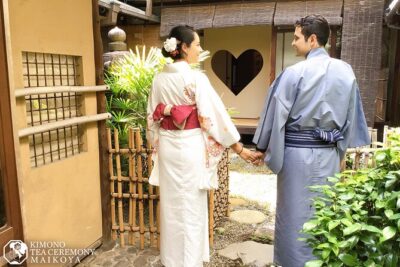
- Costumes include a bridal uchikake and men’s haori: Props such as folding fans and swords add a playful photo session to the traditional setting.
- Translation devices remove the language barrier: You do not need Japanese, and children can ask questions in their own language.
- Private groups of two to six people: This suits families, couples, and small groups who want a more personal evening activity.
- Matsuda and Mayumi create the welcoming tone: Their warmth and willingness to explain the details are a major part of the appeal.
A candlelit Kyoto setting away from the big temples
Kyoto’s major temples close at night, but the city’s cultural life does not stop when the gates shut. This experience gives you an evening activity that feels tied to Japan rather than simply filling a spare hour after dinner.
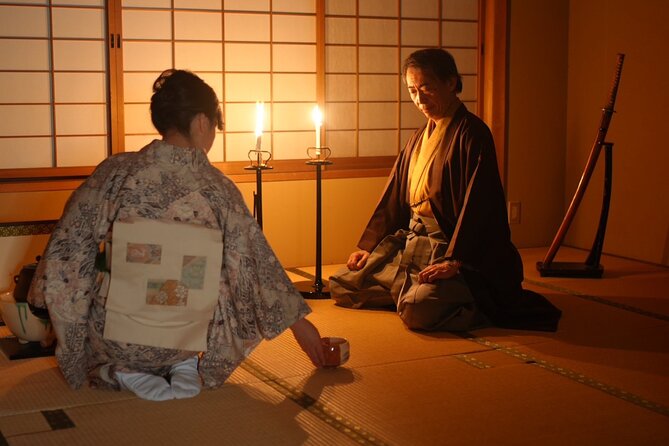
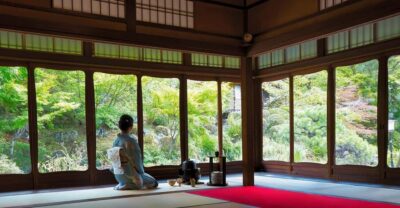
The setting is a traditional Kyoto ryokan, or Japanese inn, at 490 Kanayacho in Kyoto’s Shimogyo Ward. The activity takes place on the fourth floor of Ryofuso, in a 20-tatami banquet hall that is usually closed to the public. Tatami mats, low seating, formal utensils, and candlelight create a very different mood from a daytime sightseeing stop.
The room is intentionally dark, with candle flames providing the main light. That makes the ceremony feel calm and theatrical, though it may not suit you if you prefer a bright, highly instructional class. The darkness is part of the design, not a fault, but it can also make the experience feel more like a cultural performance than an ordinary tea lesson.
The group size is limited to two to six people, and only your party takes part. That matters. You can ask questions, take photos, and follow the demonstrations without feeling watched by a large audience. For a family, the private format also gives children room to be curious without interrupting a larger class.
More Private Tea Experiences in Japan
- Private Tea Ceremony and Sake Tasting in Kyoto Samurai House
★ 5.0 · 163 reviews - Kyoto: Private Tea Ceremony with a Garden View
★ 4.9 · 61 reviews - Kyoto Private Tea Ceremony with Tea Master at Home
★ 5.0 · 58 reviews
The first 15 minutes: kimono, props, and photographs
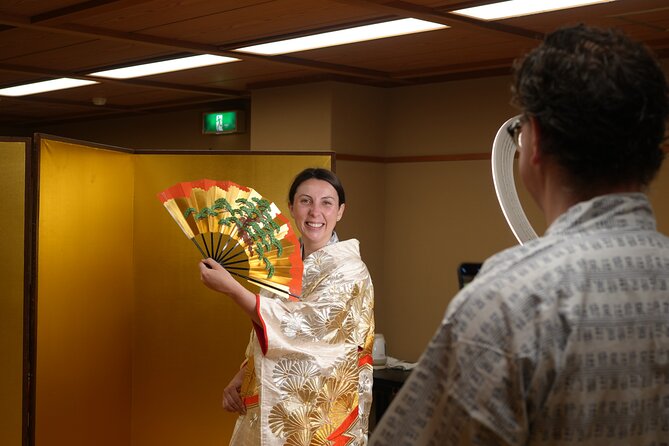
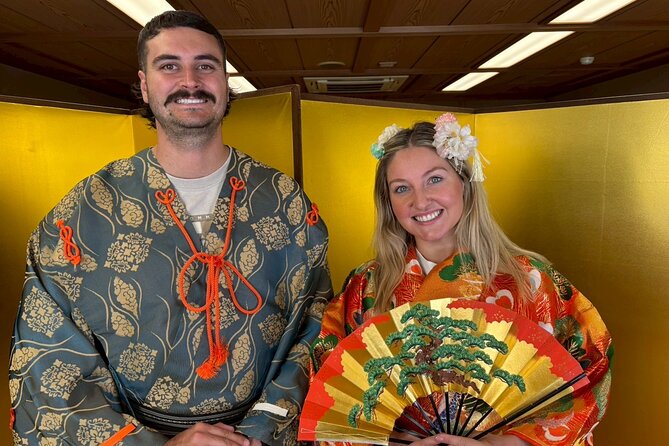
The program begins with kimono dressing and a photo session lasting about 15 minutes. Depending on your party, you may wear a bridal uchikake or a men’s haori. Folding fans and swords are available as props, and staff help with the photography.
This opening is less about learning tea and more about setting the mood. The costumes give you an immediate visual connection to Japanese tradition, while the professional lighting helps produce better photographs than quick phone snapshots in a dim room. Staff assistance is useful here because the candlelit setting would otherwise make photos difficult.
I would think of this part as a lighthearted portrait session. It is especially well suited to families, couples, and children who enjoy dressing up. The sword and fan props add some fun, so the tone is not solemn from the first minute.
There is one tradeoff. Fifteen minutes is enough for a few portraits, but not for a full kimono dressing experience or a detailed lesson in clothing. If your main goal is to study tea, the costume portion takes time away from the ceremony itself. If you want memorable photos from Kyoto, it adds real value.
Four quiet minutes of Zen meditation
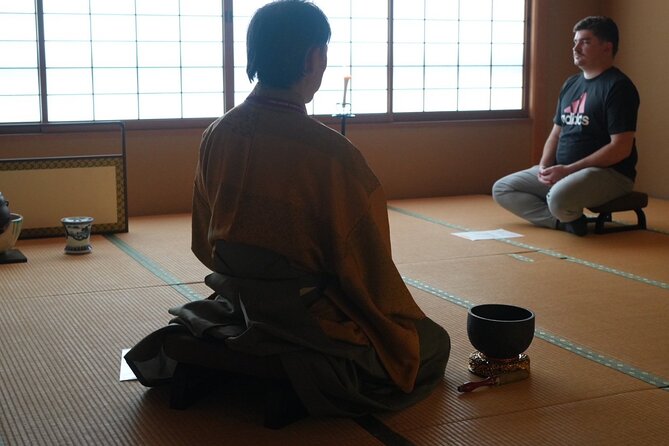
After the photos, you spend about four minutes in Zen meditation. This is brief, but the timing makes sense. The program shifts from playful photographs to a quieter frame of mind before the tea ceremony begins.
Do not expect a long meditation class. Four minutes gives you a pause, not a complete introduction to Zen practice. You may find it useful as a simple reset, especially after a day of temples, shopping, and crowded streets.
The meditation also helps explain the evening’s structure. Japanese tea practice is not only about drinking matcha. It also places importance on attention, order, and the relationship between host and visitor. Even a short period of silence can make you more aware of the movements that follow.
For children, this may be the hardest part. The private room helps, since a child can remain with the family rather than disrupt a large class, but four quiet minutes can still feel long to a young child. The rest of the activity is more hands-on.
The 20-minute tea ceremony demonstration
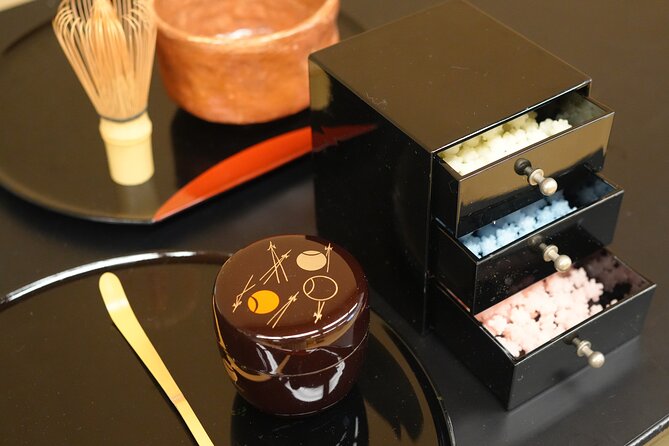
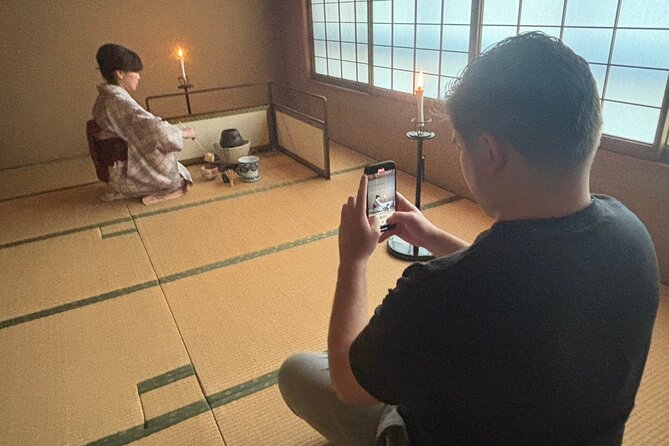
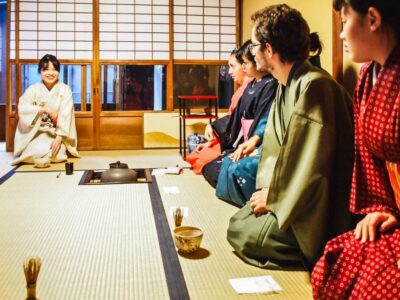
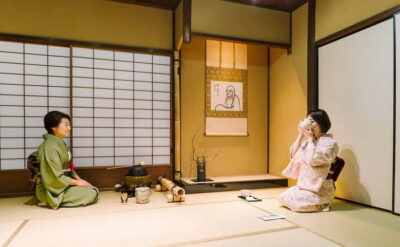
The central demonstration lasts about 20 minutes. You are welcomed as a participant in a traditional tea gathering, watch the preparation, receive a bowl of matcha, and follow the formal flow of the meeting.
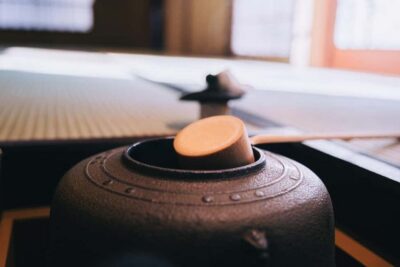
This is where the experience gains its cultural weight. Tea ceremony is built around small actions: preparing the bowl, handling the utensils, serving the tea, and acknowledging the person who receives it. The point is not speed. It is careful attention to each step.
You do not need prior knowledge. The hosts guide you through what is happening, and translator devices allow communication across languages. That support is important because tea ceremony has many gestures that are easy to miss if you only watch silently.
The demonstration is also more personal than a stage show. With only your own party present, you can ask about the utensils, the matcha, or the order of the ceremony. The hosts, Matsuda and Mayumi, are praised for their friendly manner and willingness to show the details. Their warmth keeps the formal elements from feeling intimidating.
Still, keep your expectations realistic. In 20 minutes, you will see the shape and meaning of a tea gathering, not master its etiquette. The experience is an introduction designed for visitors with limited time. Anyone seeking a serious, extended study should look for a longer tea school or repeated lessons.
More Tea Ceremonies in Kyoto
- Kyoto: Tea Ceremony in a Traditional Tea House in Kiyomizu
★ 4.9 · 3,519 reviews - Kyoto: Tea Ceremony Ju-An at Jotokuji Temple
★ 4.9 · 3,207 reviews - Kyoto: 45-Minute Tea Ceremony Lesson Experience
★ 4.3 · 2,378 reviews - Kyoto: Table-Style Tea Ceremony at a Kyo-Machiya
★ 4.9 · 1,211 reviews
The final 20 minutes: make your own matcha

The last section gives you about 20 minutes to whisk your own matcha. This hands-on part is likely to be the most engaging for many people because you move from watching to doing.
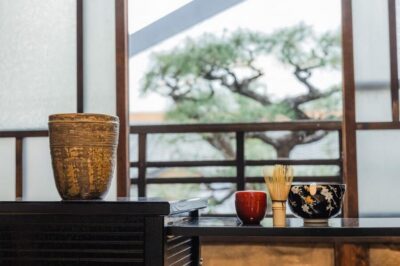
You receive the tools and instruction needed to prepare the tea. Matcha and Japanese sweets are included, so the tasting is part of the program rather than an extra purchase. Making the tea yourself also gives you a better feel for the work behind the smooth, frothy bowl served during the demonstration.
The hosts can correct your technique and answer questions through the translation devices. That makes the activity accessible even if you have never handled a bamboo whisk. Children who may lose interest during the formal demonstration have a clear task here.
The flavor of matcha can surprise first-time drinkers. It is grassy, bitter, and more concentrated than ordinary green tea. The sweets help balance it. If you already enjoy matcha, you will appreciate the chance to prepare it in a proper setting. If you do not, the experience is still useful because you can understand how the tea is made rather than simply deciding whether you like the taste.
Why the private format matters
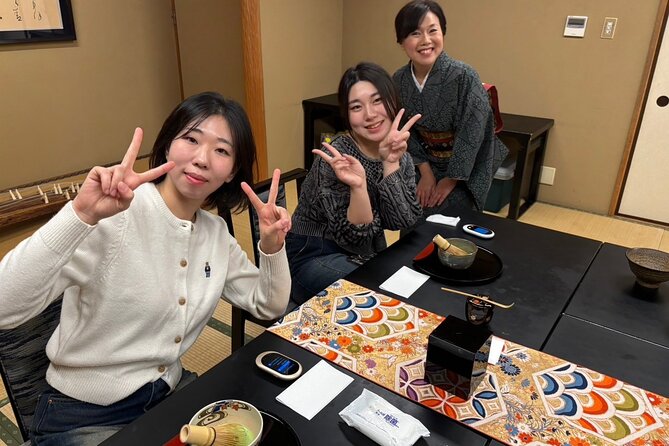
A private activity for two to six people offers a different experience from a large cultural class. You do not have to compete for the instructor’s attention, and the hosts can adjust their explanations to your group.
This is especially valuable when children are involved. One family described how even children who did not speak English could ask questions in their own language through the translation devices. That is a small but important detail. Cultural activities work better when young participants can take part directly instead of watching adults handle everything.
The private setup also suits couples who want a quiet evening, or friends who prefer an activity with a clear beginning and end. You can take photos throughout, and staff assist with the camera work.
The limitation is that the small-group setting does not automatically make the ceremony more advanced. You receive more attention, not necessarily more time. The whole program remains under an hour.
Translation devices and the role of the hosts
No Japanese is required. Translation devices are provided so that Matsuda and Mayumi can explain the ceremony and respond to questions from international visitors.
This is more useful than a printed explanation alone. Tea ceremony includes etiquette and gestures that can be difficult to understand from visual clues. A live explanation helps you know what to do, when to bow, how to receive the bowl, and why certain movements matter.
The hosts are a key part of the experience. Their friendly, cheerful approach keeps the evening from becoming overly formal. They appear to enjoy introducing the ceremony, and that enthusiasm comes through in the way they explain the details.
You should still expect some translation to feel less natural than a conversation in your own language. Electronic translation is a practical tool, not magic. But the device removes the biggest barrier and lets the hosts communicate with families who speak different languages.
What the $97.98 price includes
The listed price is $97.98 per person. The detailed local pricing gives an adult rate of ¥15,000 and a rate of ¥3,000 for children under 15, so check the amount shown at the time you reserve.
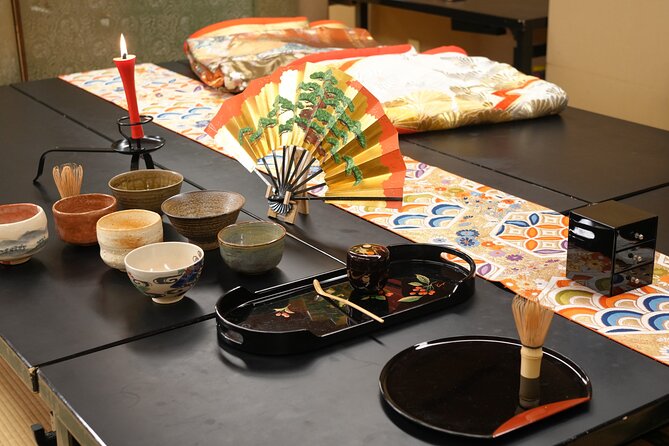
The value depends on what you want from the evening. You are not paying only for a cup of tea. The price covers a private room, a licensed guide, kimono or haori costumes, photo assistance, professional lighting, props, Zen meditation, a tea demonstration, matcha preparation, sweets, and translation support.
For a small group, that package can make sense. A private cultural activity with staff attention and a special room usually costs more than a basic public tasting. Families may find the children’s price particularly helpful, assuming the booking applies the stated rate.
For a solo visitor, the cost is harder to justify because the activity is designed for private groups of two to six. Couples and families get more value from the room and the personal instruction. I would also compare the experience with your evening plans. If you already have a full day of paid cultural activities, this may feel expensive for less than an hour. If you want one polished evening experience with photographs, the price is easier to defend.
Location, timing, and booking details
The meeting point is ZEN: Tea Ceremony Experience in Kyoto, at 490 Kanayacho, Shimogyo Ward, Kyoto 600-8323, on the fourth floor of Ryofuso. The activity ends at the same place.
The location is near public transportation, but the supplied information does not give a station name or walking time. I would allow extra time to locate the building and reach the fourth floor, especially if you are arriving after dark. Save the address on your phone, and keep the mobile ticket ready.
The activity lasts about 59 minutes. It is easy to place before dinner or after an afternoon of sightseeing, but allow time for transportation and finding the inn. Advance reservation is required, and the activity is often booked about eight days ahead. I would reserve earlier if your Kyoto schedule is tight.
Free cancellation is available up to 24 hours before the start time for a full refund. Cancellations or changes inside that window are not accepted, and no refund is provided. The operator also lists weather and minimum-number conditions, with a different date or full refund offered if the activity is canceled for either reason.
Who will enjoy this Kyoto evening
I would recommend this experience to:
- Families who want an activity children can actively join
- Couples looking for a quiet cultural evening
- First-time visitors who want a clear introduction to tea ceremony
- Small groups interested in photographs as well as tradition
- Anyone who wants a Kyoto activity after the main temples have closed
I would be more cautious if you want a long, scholarly tea lesson, a full kimono dressing service, or a large meal with the ceremony. None of those is the main purpose here. The program is short, friendly, visual, and hands-on.
The perfect audience is someone who values access and atmosphere. You get a glimpse of formal tea culture, then try the matcha yourself, with enough explanation to make the ritual understandable.
Should you book this tea ceremony?
Book it if you want a private, well-organized introduction to Japanese tea culture with photos and hands-on participation. The candlelit inn, small group size, translator devices, and kind hosts give it more character than a quick tea tasting.
I would especially choose it for a family or couple with one evening free in Kyoto. The price is not low for 59 minutes, but the costumes, private room, staff photography, meditation, sweets, and matcha lesson make the package broader than the title suggests.
Skip it if you want an extended ceremony or a specialist course. For most visitors, though, it offers a pleasant way to meet Kyoto’s traditions after dark without needing Japanese or prior knowledge.
FAQ
Where does the tea ceremony take place?
It takes place at ZEN: Tea Ceremony Experience in Kyoto, at 490 Kanayacho, Shimogyo Ward, Kyoto 600-8323, on the fourth floor of Ryofuso.
How long does the experience last?
The experience lasts approximately 59 minutes.
How many people can join a private group?
The private activity is available for groups of two to six people.
Is Japanese language ability required?
No. Translation devices are available, so you can communicate with the hosts without speaking Japanese.
What is included in the tea ceremony?
The experience includes matcha green tea, sweets, costumes, a bridal uchikake or men’s haori, props, tea ceremony utensils, photography assistance, Zen meditation, and a licensed guide.
Can children take part?
Yes. Children under 15 have a stated price of ¥3,000, while adults are listed at ¥15,000. The program also includes hands-on matcha making and translation support.
Can I cancel for a full refund?
Yes. You can cancel at least 24 hours before the start time for a full refund. Cancellations or changes made less than 24 hours before the start time are not refunded or accepted.
More Private Tea Experiences in Kyoto
- Stunning Private Tea Ceremony: Camellia Garden Teahouse
★ 5.0 · 28 reviews - KYOTO: Private Tea Ceremony in Hidden Townhouse (Kid-Friendly)
★ 5.0 · 20 reviews - Kyoto Private Tea Ceremony at a Japanese Inns
★ 5.0 · 3 reviews - Kyoto Newly Opened Private Tea Ceremony – Sanjo Chasuian
★ 5.0 · 2 reviews
Just added around Kyoto
- Uji Walking Tour – Byodo-in temple and Tea Ceremony from Kyoto★ 3.5 · 3 reviews
- Tea ceremony at Kyoto’s Zen Temple Teahouse★ 5.0 · 2 reviews
- Kyoto: Authentic Tea Ceremony in a Small Group★ 5.0 · 7 reviews
- Tea Ceremony in 150 Years Old Townhouse with Tables and Chairs★ 5.0 · 22 reviews
- Traditional Tea Ceremony in Kyoto★ 4.5 · 3 reviews
- Silent Beauty of Kyoto Zen Walk and Tea Experience★ 5.0 · 2 reviews
- Tea Ceremony Experience in Traditional Kyoto Townhouse★ 5.0 · 19 reviews
- Kyoto Newly Opened Private Tea Ceremony – Sanjo Chasuian★ 5.0 · 2 reviews
Tea Ceremonies in Kyoto, compared.
Tea Ceremony in a Traditional Tea House in Kiyomizu
Read our review →
Tea Ceremony in 100-year-old Kyo-Machiya Townhouse
Read our review →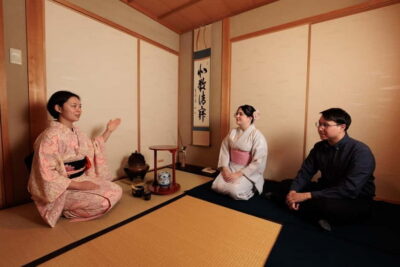
Browse the lists this tour appears in