
Review · KYOTO
Kyoto: Tea Ceremony with Maiko
Kyoto comes alive in 45 minutes. This short tea experience brings you close to a maiko, the traditional apprentice entertainer associated with Kyoto’s geisha districts, while giving you a hands-on lesson in making matcha. I especially like the direct Q&A, which turns a pretty photo opportunity into a chance to learn about a demanding and little-seen way of life. The $28 price is also reasonable for a central Kyoto activity that includes tea, sweets, a photo, and a small gift. The main consideration is that the event takes place in a building near Gojo Station, not in a traditional tea house or old Japanese home.
If your Kyoto schedule is tight, this is an easy cultural stop to fit between sightseeing plans. Masaya-san, one maiko named in the experience feedback, received particular praise for making the tea lesson clear and answering questions through an interpreter. You should also expect Japanese to be the main language, with English help provided as much as possible.
Key points at a glance
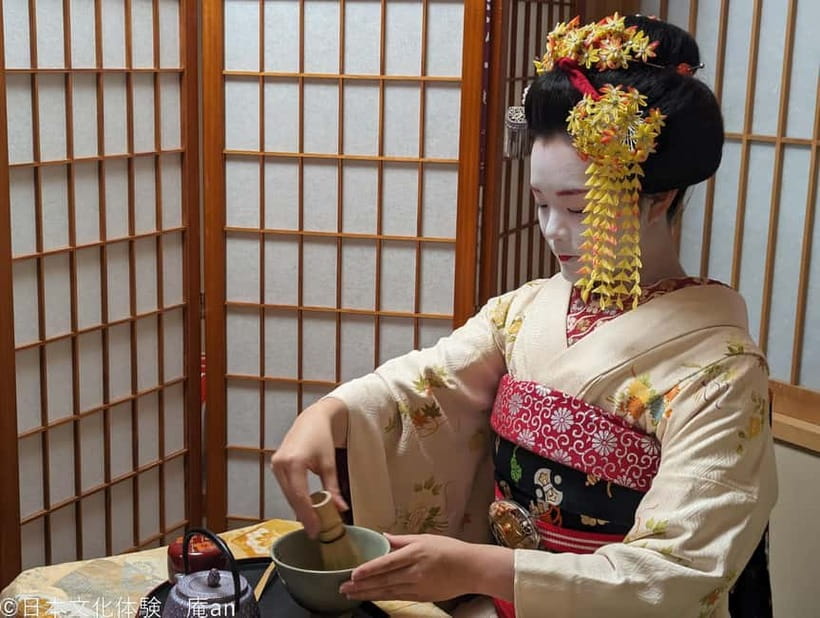
- A real maiko leads the central experience: You watch a demonstration, prepare your own matcha, and ask questions about her life.
- The location saves time: The venue is about a one-minute walk from Exit 1 of Gojo Station, close to Kyoto Station.
- Two Japanese sweets are included: You receive dried-style sweets called ohigashi with your matcha.
- The Q&A is the heart of the visit: You can ask directly about maiko life and the path toward becoming a geiko.
- Photos and a Senjafuda are part of the price: You can take a commemorative photo beside the maiko and receive a lucky paper charm.
- The setting is simple, not historic: Expect a relaxed room in a building, with stairs and no elevator.
A quick way to meet Kyoto’s maiko tradition
Kyoto can make traditional culture feel hard to reach. You might spot a maiko hurrying through Gion, but that is not the same as having time to speak with one. This experience gives you a respectful, arranged meeting in a controlled setting, without asking you to chase anyone through the streets.
The program is designed for efficiency. The main activities finish at about 30 minutes, and the full room departure takes about 45 minutes. That makes it useful before lunch, after a morning visit to Fushimi Inari, or during a short stay near Kyoto Station.
I like the balance here. You do not simply watch a staged appearance. You see how matcha is prepared, try it yourself, ask questions, and have a photo taken. The event is brief, but it offers several ways to connect with the subject.
Still, you should set your expectations correctly. This is not an ochaya, the traditional establishment associated with geisha entertainment, and it is not held in a historic Japanese house. The venue is inside a building, with a relaxed atmosphere and friendly staff. For some people, that plain setting may feel less atmospheric than a formal tea room. For others, it makes the experience less intimidating and much easier to fit into a busy day.
More Kimono and Tea Ceremonies in Kyoto
- Kimono Tea Ceremony at Kyoto Maikoya, NISHIKI
★ 5.0 · 911 reviews - Kyoto: Kimono Tea Ceremony at Orizuruya Gion
★ 4.9 · 618 reviews - KYOTO Tea Ceremony with kimono near by Imamiya Jinjya Shrine
★ 5.0 · 343 reviews
Finding the venue near Gojo Station
The meeting point is about one minute from Exit 1 of the Subway Karasuma Line’s Gojo Station. The entrance faces Gojo-dori, the main street, but the location can still be easy to miss.
A useful route is to leave through Exit 1, walk straight, cross a small street, and continue ahead. The venue is above the supermarket Carnival, before the next small street. You then go upstairs to reach the room.
Give yourself extra time. One person found the location difficult to identify, and this is exactly the kind of stop where arriving early matters. The program will not wait for late arrivals, and latecomers are not entitled to a refund. I would aim to be in the area at least 10 to 15 minutes before the scheduled start.
The building has no elevator. You need to use stairs to reach the venue, so keep that in mind if you have mobility concerns or are carrying large luggage. The location is convenient for the subway, but it is not designed as a fully accessible attraction.
The opening greeting and first look at the maiko
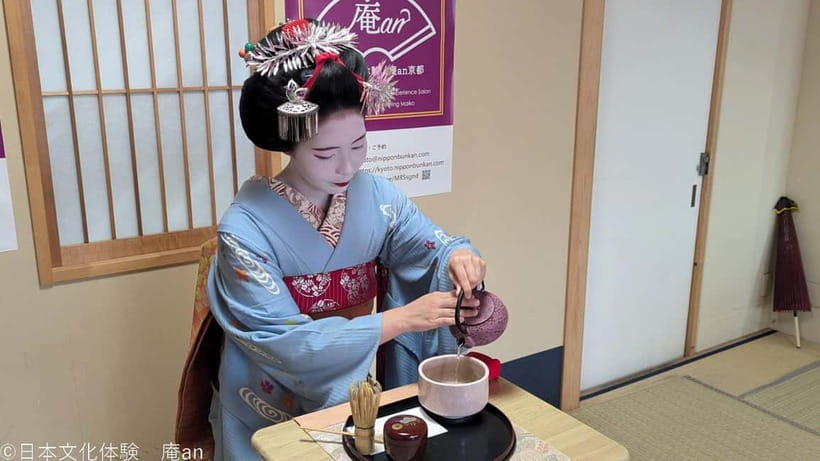
The session begins with a greeting from the maiko. Depending on the date, the host may be a maiko or a geiko. A maiko is an apprentice, while a geiko is a fully trained performer, so the person leading your session may differ from the photographs or wording used when you book.
That variation is worth accepting. Both roles are part of Kyoto’s traditional entertainment culture, and the chance to speak with either one can be meaningful. If meeting specifically a maiko is essential to your plans, check the date details before booking.
The presentation is close enough for you to notice the formal hairstyle, kimono, and makeup, but the setting remains relaxed. The point is not to watch from a distance. The staff arrange the room so you can listen, participate, and later stand beside the performer for a photo.
The atmosphere may not be silent or ceremonial throughout. The event can be held in a room with people who are also having lunch or dinner. If you need the hushed feel of a private tea room, this may feel more casual than expected.
Making matcha instead of only watching
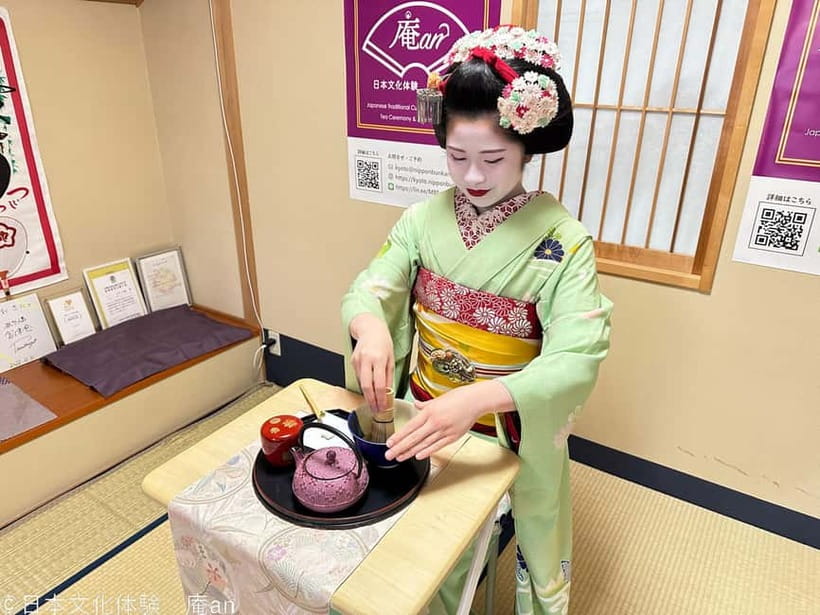
The tea portion begins with a demonstration. The maiko shows you how to prepare matcha and explains what to do. You then make your own cup.
That hands-on step gives the program more value than a simple cultural display. Matcha preparation looks calm and precise, but the basic process becomes easier to understand once you hold the whisk and follow the instructions. You are not expected to arrive with special training or knowledge of Japanese tea ceremony customs.
The included serving comes with two dried Japanese sweets, called ohigashi. These are small, firm sweets traditionally served with tea, and their sweetness helps balance the strong, grassy flavor of matcha. They are not a full snack or meal, so plan food separately if you are hungry.
I would treat this as an introduction rather than a formal tea ceremony lesson. You get the essence of preparing and drinking matcha, but the short schedule does not allow for an extended study of tea utensils, schools of tea, or detailed etiquette. That is not a flaw at this price and duration. It simply tells you what kind of experience you are buying.
More Tea Ceremonies in Kyoto
- Kyoto: Tea Ceremony in a Traditional Tea House in Kiyomizu
★ 4.9 · 3,519 reviews - Kyoto: Tea Ceremony Ju-An at Jotokuji Temple
★ 4.9 · 3,207 reviews - Kyoto: 45-Minute Tea Ceremony Lesson Experience
★ 4.3 · 2,378 reviews - Kyoto: Table-Style Tea Ceremony at a Kyo-Machiya
★ 4.9 · 1,211 reviews
Why the question-and-answer period matters
The Q&A is one of the strongest parts of the program. You can ask about the maiko’s daily life, training, work, and eventual path toward becoming a geiko. This is where the experience moves beyond costume and ceremony.
The questions are answered in Japanese. English translation is offered as much as possible, and you should contact the provider if you would like English assistance arranged. The quality of the exchange can depend on the interpreter and the pace of the session, but the staff have been praised for helping everyone follow along.
Masaya-san was singled out for answering questions with confidence through an interpreter. That detail matters because the Q&A is only useful if you understand the answers. If you have a question you especially want to ask, prepare it in simple English and be ready for a translated response.
This is also a good place to remember that maiko culture is a working tradition, not a costume theme. Ask respectful questions about training and daily routines, and listen to the answer rather than treating the performer as a character in a show. The arranged setting lets you learn without intruding on someone moving through a public street.
The photo and Senjafuda gift
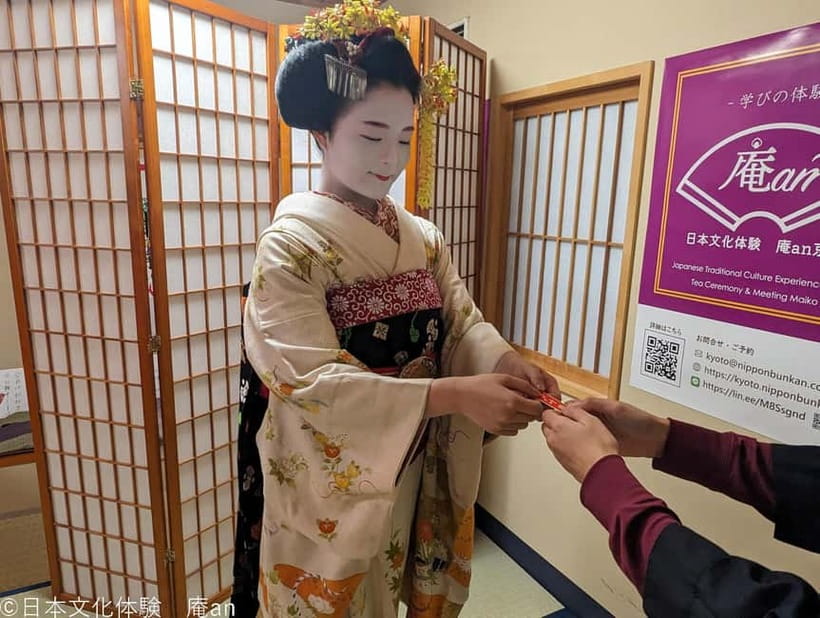
Near the end, you can take a commemorative photo beside the maiko. This is a close photo opportunity, not a distant stage picture. Staff help organize the moment so you can leave with a clear memory of the meeting.
The experience also includes a Senjafuda, a small lucky paper charm traditionally associated with a person’s name or mark. It is a modest gift, but it adds a personal finish to the program. You receive something more lasting than a cup of tea, without paying extra for the photo or charm.
The exact order can vary slightly. The stated schedule has the tea ceremony and Q&A finishing around the 30-minute mark, followed by the photo and Senjafuda presentation before departure at about 45 minutes. Keep your camera or phone ready, but do not let the photo take over the experience. The conversation and tea lesson offer more substance.
Some feedback also describes added elements such as a dance performance or a game, but these should not be treated as guaranteed parts of the standard booking. The reliable inclusions are the tea ceremony, two sweets, matcha, Q&A, photo opportunity, and Senjafuda.
What $28 buys you in Kyoto
At $28 per person, this is a fair value if you want several small experiences combined into one short visit. You receive a guided cultural activity, matcha, two sweets, direct time with a maiko or geiko, a photo opportunity, and a keepsake.
The price is especially useful for a first visit to Kyoto. A longer tea ceremony or formal cultural show may cost more and require a larger block of your day. Here, you can learn the basics, meet a performer, and then continue sightseeing.
The value depends on your expectations. If you are mainly paying for an ornate historic setting, the building will disappoint. If you are paying for direct conversation and a chance to make tea with guidance, the price works well.
Children who need their own seat pay the same fee as one adult. Children under two who sit on a parent’s lap are free. That rule makes a difference for families deciding if the short activity fits their day.
Language, timing, and practical cautions
Japanese is the listed language of the activity. English translation can be provided as much as possible, but it is not presented as a fully English-led program. Contact the provider ahead of time if language support is important to you.
The experience runs between 10:00 AM and 5:00 PM, with available start times shown during booking. Reservations received after 5:00 PM are processed the following day.
Arrive early. The event does not pause for delayed arrivals, and missed participation does not qualify for a refund. People who are not participating cannot enter the experience, so do not expect to wait inside while another person in your group takes part.
Cancellation terms are strict close to the date. You can cancel up to eight days in advance for a full refund, while changes within seven days may incur a fee. The provider does not cover transportation costs if the activity is canceled, so avoid booking it too tightly against a train or other fixed appointment.
Who will enjoy this experience most
I would recommend this for you if you want a short, approachable introduction to Kyoto’s traditional performing culture. It works particularly well if you are staying near Kyoto Station, using the Karasuma subway line, or fitting several activities into one day.
It also suits people who value conversation. The maiko’s presence is attractive, but the chance to ask questions gives the experience its strongest educational element. Families, couples, solo visitors, and small groups can all take part without special preparation.
You may want to skip it if your main goal is a formal tea ceremony in a historic home. You may also want to look elsewhere if you need guaranteed English instruction, an elevator, or a completely quiet room. The setting is practical and casual rather than grand.
For photography-minded visitors, the activity offers a close portrait opportunity, but the photo is only one part of the program. I would not book it solely for a picture. Book it because you want the photo plus a brief lesson, a cup of matcha, and a direct exchange.
Should you book the Kyoto maiko tea ceremony?
Yes, if you want an affordable and time-efficient way to meet a maiko or geiko and learn about her world. The strongest reasons to book are the central location, personal Q&A, easy matcha lesson, included sweets, and photo with a Senjafuda gift.
Go in knowing that the venue is a plain building, English support is limited, stairs are required, and the performer may be a geiko instead of a maiko. Arrive early, confirm the language arrangements, and allow 45 minutes rather than rushing off after the first half hour.
For $28, this is a sensible Kyoto add-on. It will not replace a full tea school lesson or a traditional ochaya visit, but it gives you a respectful, compact look at a culture that can otherwise be difficult to encounter directly.
FAQ
How long does the tea ceremony with maiko last?
The full experience takes about 45 minutes. The tea ceremony and Q&A finish at around 30 minutes, followed by the photo opportunity and Senjafuda gift before you leave.
How much does the experience cost?
The price is $28 per person.
Where is the meeting point?
The venue is about a one-minute walk from Exit 1 of Gojo Station on the Subway Karasuma Line. The entrance faces Gojo-dori and is located above the Carnival supermarket.
Is the activity held in a traditional Japanese house?
No. It is held inside a building rather than an ochaya or traditional Japanese house. The venue has a relaxed atmosphere and friendly staff.
Will the experience definitely be hosted by a maiko?
Not always. Depending on the date, the session may be hosted by either a maiko or a geiko.
Is English available?
Japanese is the listed language. English translation can be provided as much as possible, and you should contact the provider if you would like to request it.
Are matcha and sweets included?
Yes. The price includes matcha and two dried-style Japanese sweets called ohigashi.
Can children join for free?
Children under two years old can join free if they sit on a parent’s lap. Children who need their own seat pay the same fee as one person.
Just added around Kyoto
- Uji Walking Tour – Byodo-in temple and Tea Ceremony from Kyoto★ 3.5 · 3 reviews
- Tea ceremony at Kyoto’s Zen Temple Teahouse★ 5.0 · 2 reviews
- Kyoto: Authentic Tea Ceremony in a Small Group★ 5.0 · 7 reviews
- Tea Ceremony in 150 Years Old Townhouse with Tables and Chairs★ 5.0 · 22 reviews
- Tea Ceremony Experience in Traditional Kyoto Townhouse★ 5.0 · 19 reviews
- Traditional Tea Ceremony in Kyoto★ 4.5 · 3 reviews
- Silent Beauty of Kyoto Zen Walk and Tea Experience★ 5.0 · 2 reviews
- Kyoto Private Tea Ceremony at a Japanese Inns★ 5.0 · 12 reviews
Tea Ceremonies in Kyoto, compared.
Tea Ceremony in a Traditional Tea House in Kiyomizu
Read our review →
Tea Ceremony in 100-year-old Kyo-Machiya Townhouse
Read our review →
Browse the lists this tour appears in