
Review · KYOTO
Kyoto: Tea Ceremony with Maiko Premium
Meet a living Kyoto tradition. This 90-minute program combines a matcha lesson, two graceful maiko dances, a question-and-answer session, photographs, and traditional games for about $50. I especially like the direct conversation with the performer and the chance to make your own tea rather than simply watch a demonstration.
The premium format gives you much more than a short photo stop. You receive two Japanese sweets, a Senjafuda lucky charm, and time to see the maiko at close range. The main drawback is the setting: this takes place in a modern building with tables, stools, and company advertising in the background, not in a traditional tatami room or ochaya.
Key points at a glance
- Two dances are included: The maiko performs twice, with each dance expressing seasonal beauty, romance, or daily life.
- You make your own matcha: The maiko demonstrates the process, then guides you as you prepare your tea.
- The questions are unusually personal: You can ask about training, daily routines, kimono, hairstyles, and life as a maiko.
- The mood is friendly, not stiff: Games and conversation make this suitable for families as well as adults.
- The location is easy to reach: The venue is one minute from Exit 1 of Gojo Station on the Karasuma Subway Line.
- A geiko may appear instead: The performer can change depending on the day, so the program is not always led by a maiko.
Why this Kyoto experience works
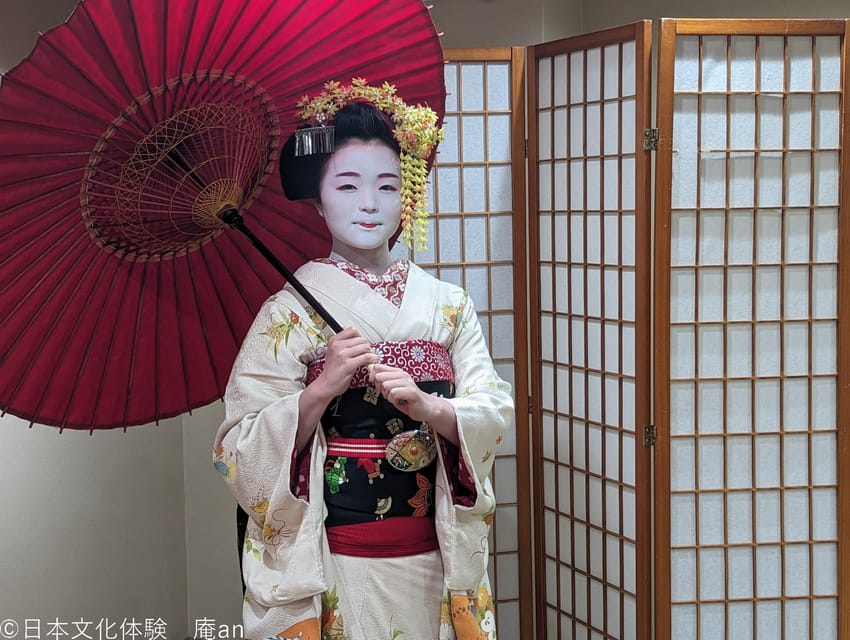
Kyoto’s maiko are apprentice entertainers trained in traditional music, dance, conversation, and hospitality. Their elaborate kimono, formal hairstyles, makeup, and carefully practiced movements make them instantly recognizable, but a short street sighting tells you very little about their lives.
This program gives you time to look past the costume. You can ask direct questions and hear about the training required to become a geiko. One part of the presentation explains that the path can take about five years, which gives some weight to the graceful performance you see later.
I like that the program does not treat the maiko as a decoration. She speaks with the group, answers questions, demonstrates tea preparation, and joins the games. The host helps keep things moving, and some hosts, including Karen, have been praised for making the explanations clear and friendly.
The format is still a group activity. You will not be sitting privately with a maiko in an old teahouse. If you want quiet ceremony and historic surroundings, this will feel more like a cultural presentation. If you want access, explanation, and a chance to interact, the modern format has real advantages.
More Kimono and Tea Ceremonies in Kyoto
- Kimono Tea Ceremony at Kyoto Maikoya, NISHIKI
★ 5.0 · 911 reviews - Kyoto: Kimono Tea Ceremony at Orizuruya Gion
★ 4.9 · 618 reviews - KYOTO Tea Ceremony with kimono near by Imamiya Jinjya Shrine
★ 5.0 · 343 reviews
Finding the venue near Gojo Station
The meeting point is about one minute from Exit 1 of Gojo Station on the Karasuma Line. The entrance faces Gojo-dori, a useful detail because the building itself is not presented as a grand historic teahouse.
Allow extra time to find the entrance and climb the stairs. There is no elevator in the building, and the experience will not wait for late arrivals. The operator also does not hold the program for transport delays, so arriving around 15 minutes early is sensible.
That early arrival may have another benefit. One person noted that arriving before the start could allow you to see the maiko arrive by taxi. This is not a scheduled part of the program, so treat it as luck rather than an included feature.
The room has tables and stools rather than tatami flooring. The maiko sits behind a small table, and the background can include large advertisements, a company name, or a QR code. That can spoil an otherwise lovely photograph. The room is relaxed and the staff are welcoming, but the setting does not create the atmosphere of a traditional Japanese house.
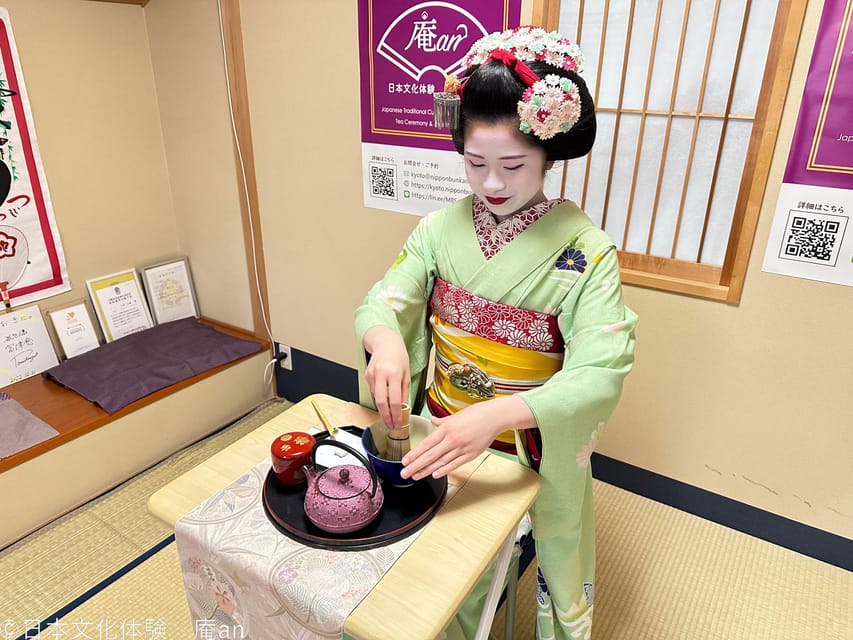
The opening greeting and matcha lesson
The program begins with a greeting from the maiko. She then demonstrates how to prepare matcha and explains the basic steps before you make your own cup.
This is not presented as a highly formal tea ceremony. The tea is straightforward, and the setting is not ceremonial in the old-fashioned sense. That may disappoint you if you expect a long, silent ritual with exact movements and traditional architecture.
For most people, though, the hands-on element is the better choice. You are not just watching a cultural display. You handle the whisk, prepare the tea yourself, and gain a simple understanding of what goes into the drink. Two dried Japanese sweets are served with the matcha, giving you the classic pairing of a sweet bite before the slightly bitter tea.
The lesson works well for families because it gives children something active to do. Children aged four and ten have been reported as enjoying the program as much as adults, and the format avoids asking young participants to sit silently for the entire 90 minutes.
Free snacks and a drink are included, along with the tea and sweets. Another drink may be available for purchase inside, but it is not part of the base price.
The question-and-answer session
The Q&A is one of the strongest parts of the program. You can ask about the maiko’s training, routines, clothing, hairstyle, work, and traditions. This is where the experience becomes more than a staged performance.
The questions are handled with help from the host, and English translation is provided as much as possible if requested. The official operating language is Japanese, so you should contact the operator in advance if English support matters greatly to you.
Some sessions have included hosts who speak both Japanese and English. Still, the quality of translation can depend on the host and the questions asked. Keep your questions short and clear, and avoid assuming that every detail of maiko life is identical from person to person.
The maiko’s answers also help explain why the appearance is so carefully managed. The kimono, hairstyle, makeup, and manners are not casual dress-up. They form part of a demanding traditional profession that continues in modern Kyoto.
This section tends to suit adults who want cultural context, but it also gives children a chance to ask direct questions. The friendly tone makes it easier to participate without feeling that you need specialist knowledge.
More Tea Ceremonies in Kyoto
- Kyoto: Tea Ceremony in a Traditional Tea House in Kiyomizu
★ 4.9 · 3,519 reviews - Kyoto: Tea Ceremony Ju-An at Jotokuji Temple
★ 4.9 · 3,207 reviews - Kyoto: 45-Minute Tea Ceremony Lesson Experience
★ 4.3 · 2,378 reviews - Kyoto: Table-Style Tea Ceremony at a Kyo-Machiya
★ 4.9 · 1,211 reviews
Photos beside the maiko
You receive an opportunity to take a commemorative photograph beside the maiko. Depending on the room and the group, there may also be chances to photograph or record parts of the presentation.
The close-up photo is a major reason to choose this program. You see the kimono details, hairstyle, makeup, and accessories at a distance that is impossible during a brief encounter on a Kyoto street.
There is one practical warning: check the background before taking the picture. Company posters and QR codes can appear behind the performer. You may not be able to remove them from every shot, so use the angle available and take several photographs if permitted.
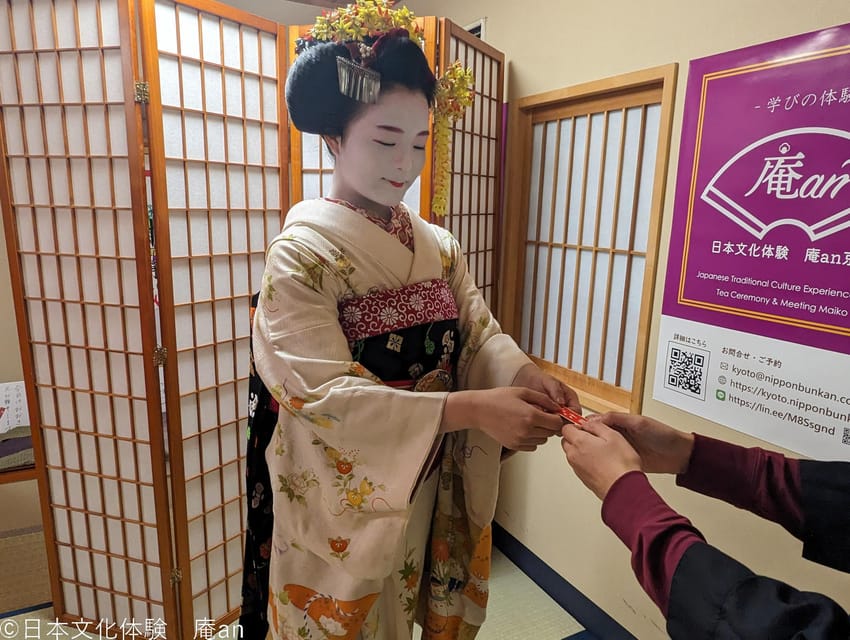
As a special gift, the maiko presents a Senjafuda. These small paper cards are associated with performers and carry a traditional good-luck meaning. It is a more personal souvenir than a generic printed ticket or postcard.
Please remember that only people booked for the activity may enter. If someone in your party does not participate, that person cannot simply come inside to watch or take photographs.
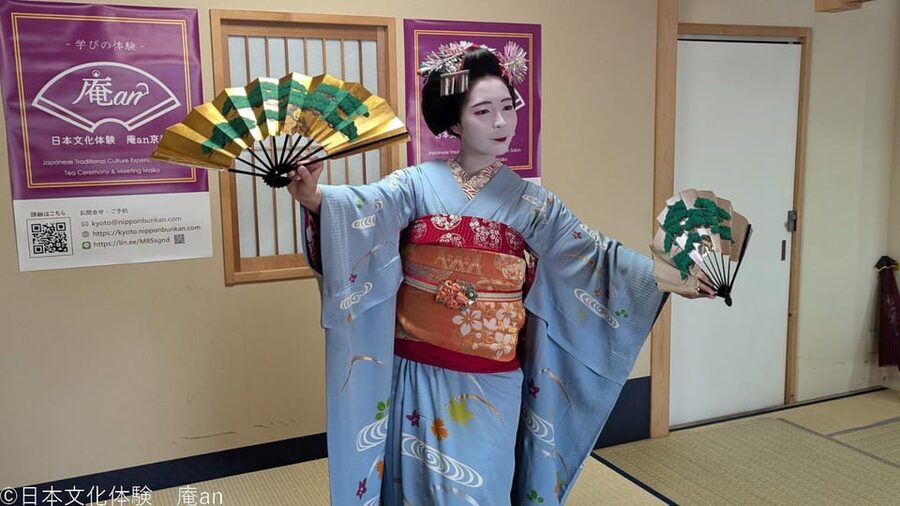
Two dances that reveal the training
The maiko performs two traditional dances. The movements are controlled and elegant, with themes connected to the seasons, love stories, or ordinary life in Japan.
These dances are brief enough to fit comfortably into the program, but they provide the most visually striking part of the afternoon or evening. The slow gestures, precise posture, and careful use of the sleeves show why maiko performances require years of training.
The room itself does not add much atmosphere. A plain wall and commercial signage can make the performance feel less special than it deserves. Still, the maiko’s skill carries the presentation, and the dances are often the moment that leaves the strongest impression.
A few practical points matter here. Seating position affects your view, and extra charges apply for better seats:
- SS, first row: 3,300 yen
- S2, second row: 2,200 yen
- S3, third row: 1,100 yen
The base price is about $50 per person, so decide if a closer view is worth adding to the cost. If photographs and the dance are your main reasons for booking, a front row may make sense. If you mainly want the conversation and tea lesson, a standard seat should be enough.
Traditional games with a maiko
The interactive game gives the program a lighter finish. Volunteers can join, while everyone else can clap, cheer, and enjoy the contest from their seat.
This part helps prevent the event from feeling like a lecture. The maiko participates directly, and the simple games make it easier for families and mixed-age groups to relax. You do not need special skills, and you can watch without volunteering.
The games also show another side of maiko hospitality. The profession is not only about formal dance and tea. Playful interaction, quick reactions, and keeping a room entertained are part of the work too.
If you prefer a quiet cultural demonstration, the game may feel less serious than the dance. I see that as a useful balance. The presentation gives you history and tradition, then allows everyone to enjoy a bit of fun before the maiko leaves.
What happens after the maiko leaves
The main program is scheduled to finish at about 75 minutes, with room departure around 90 minutes. After the maiko leaves, you have some time for chatting before leaving the building.
This final period is useful if you want to ask the host a follow-up question or take a moment to collect your belongings. It also means the experience does not end abruptly after the last game.
The total length can vary in practice. One account found the session closer to 70 minutes, so do not plan an important connection immediately afterward. The advertised duration is 90 minutes, but the precise pace can depend on the group, translation, questions, and timing.
Is $50 good value?
At roughly $50 per person, the program offers a lot in a compact period. You receive a tea lesson, matcha, two sweets, a Q&A, two dances, games, a photograph opportunity, and a Senjafuda gift.
The value is strongest if you want several elements in one booking. A simple tea lesson would not justify the price on its own, and a short dance show would leave you with less context. Here, the conversation and interaction make up much of the value.
The premium option is especially sensible if it includes the dance and game portions for your booking. Several people specifically preferred the full premium format because it turned a basic tea activity into a broader cultural program.
You should budget extra for better seating if you choose SS, S2, or S3. Also remember that a modern room and group format keep the cost below what you might expect from a private traditional tea-house encounter. You are paying for access to a trained performer and a varied program, not for an old building or a private appointment.
Who should book this program?
I would recommend it to first-time visitors who want an approachable introduction to maiko culture. It works particularly well if you want direct answers and photographs rather than a performance viewed from far away.
Families should also consider it. The matcha preparation, game, and photo opportunity give children several ways to stay involved. The program is not so formal that young participants must remain quiet and motionless throughout.
It is also a good choice for anyone with limited time in Kyoto. Ninety minutes gives you a focused cultural activity without taking up half a day. The Gojo Station location makes it simple to reach by subway.
I would be more cautious if your main goal is an old Kyoto setting. The building is modern, there is no tatami room, and commercial signs may appear in your photographs. You may also prefer another activity if you dislike group participation or do not want translation to affect the pace.
Booking details worth knowing
The activity operates between 10:00 and 17:00, and reservations received after 17:00 are handled the following day. Cancellation is free up to eight days in advance, while later cancellations can incur a fee.
If you change the date or time after a cancellation charge applies, another specified fee may be charged. The operator does not reimburse transport costs if the activity is cancelled, so check the policy carefully before making a tight travel plan.
Children under two are free when sitting on a parent’s lap. If a seat or meal is required, the adult fee applies. The building has stairs and no elevator, so consider that before booking for anyone who cannot comfortably climb stairs.
Should you book the Kyoto Maiko Premium experience?
Book it if you want interaction, context, and a close photograph in one reasonably priced Kyoto activity. The Q&A, two dances, matcha preparation, and games give the program more substance than a quick staged appearance.
Skip it if you expect a private ceremony in a historic teahouse. The room is plainly commercial, the group may be sizeable, and the background is not ideal for photographs.
For most first-time visitors, I would choose the premium format and arrive 15 minutes early. Request English support ahead of time, choose a better seat only if the performance matters greatly to you, and leave enough time afterward in case the session runs close to the full 90 minutes.
FAQ
How long does the Kyoto Maiko Premium experience last?
The scheduled duration is 90 minutes. The main program ends at about 75 minutes, followed by chatting time before room departure. The exact pace can vary.
How much does the experience cost?
The listed price is $50 per person. Extra charges apply for SS, S2, and S3 seating.
Where does the program take place?
The venue is one minute from Exit 1 of Gojo Station on Kyoto’s Karasuma Subway Line. The entrance faces Gojo-dori.
Is the venue a traditional Japanese tea house?
No. The program takes place in a building with tables and stools. It is not an ochaya or a traditional Japanese house.
Is an elevator available?
No. There is no elevator, and you need to use stairs to reach the venue.
Is the performer always a maiko?
No. Depending on the situation, a geiko may appear instead of a maiko.
Is tea included?
Yes. Matcha and two dried Japanese sweets are included, along with free snacks and a drink.
Can I take a photograph with the maiko?
Yes. The program includes an opportunity to take a commemorative photo beside the maiko.
What is the Senjafuda gift?
The maiko presents a Senjafuda, described as a lucky charm, as a special gift during the program.
Are children allowed to attend?
Yes. Children under two are free when sitting on a parent’s lap. If a child needs a separate seat or meal, the same fee as one person applies.
Just added around Kyoto
- Uji Walking Tour – Byodo-in temple and Tea Ceremony from Kyoto★ 3.5 · 3 reviews
- Tea ceremony at Kyoto’s Zen Temple Teahouse★ 5.0 · 2 reviews
- Kyoto: Authentic Tea Ceremony in a Small Group★ 5.0 · 7 reviews
- Tea Ceremony in 150 Years Old Townhouse with Tables and Chairs★ 5.0 · 22 reviews
- Silent Beauty of Kyoto Zen Walk and Tea Experience★ 5.0 · 2 reviews
- Tea Ceremony Experience in Traditional Kyoto Townhouse★ 5.0 · 19 reviews
- Traditional Tea Ceremony in Kyoto★ 4.5 · 3 reviews
- Sencha-do the Japanese Tea Ceremony Workshop in Kyoto★ 5.0 · 21 reviews
Tea Ceremonies in Kyoto, compared.
Tea Ceremony in a Traditional Tea House in Kiyomizu
Read our review →
Tea Ceremony in 100-year-old Kyo-Machiya Townhouse
Read our review →
Browse the lists this tour appears in