
Review · XIAN
Xi’an Chinese Calligraphy Workshop: Ink Art & Tea Tasting
Brushes tell stories.
This three-hour Xi’an workshop gives you a calm, hands-on way to meet Chinese culture through ink, tea, and character design. I especially like the patient English instruction from Yunyun, and the chance to take home a fan or scroll carrying words you choose yourself. You also make personalized bookmarks, so the keepsakes are useful rather than just decorative.
The main consideration is that the class is aimed at participants age 12 and older, and beginners should expect practice rather than instant mastery. At $55 per person, the price is fair for a small group of no more than eight, though you should book this for the cultural activity, not simply for a quick souvenir.
Key points at a glance
- A small class with personal help: The group is limited to eight, giving Yunyun room to correct brush position and stroke technique.
- Ancient characters made simple: You practice characters including 一, 十, 大, 小, 米, 永, 龙, 武, and 爱, then learn to write your name in Chinese.
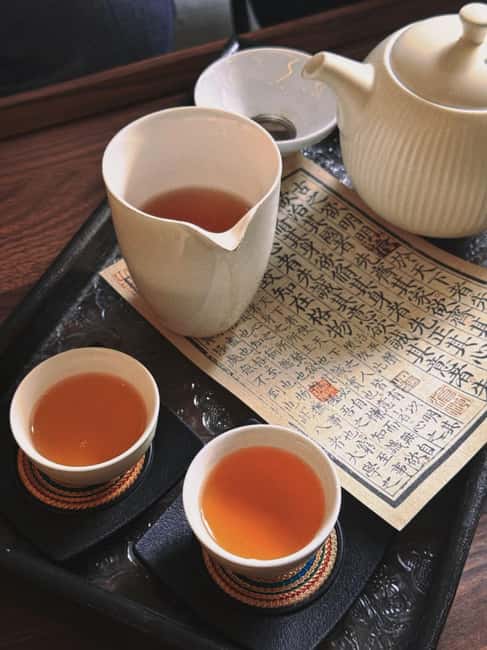
- Tea is part of the lesson: Local snacks and traditional tea add a relaxed scholar-style setting rather than making this a standard craft class.
- You choose your final artwork: Pick a painted folding fan or a traditional scroll, then select favorite words or sentences for the finished piece.
- The location is in Beilin District: The meeting point is Room 0102, Unit 1, Building 7, No. 6 Xiamaling, in central Xi’an’s Beilin District.
- English support matters: The instructor teaches in English, a major help when the subject includes both writing technique and cultural meaning.
Why calligraphy makes a good Xi’an activity
Xi’an is famous for major sights, but a few hours with a brush can show you another side of the city. This class connects your visit with the old culture of Chang’an, the historic name associated with Xi’an, through the development of Chinese characters and the discipline of brush writing.
I like that the lesson is not limited to copying attractive symbols. You learn how characters developed over roughly 3,000 years and why their shapes and meanings matter. That context helps you see calligraphy as writing, art, and cultural memory at the same time.
It also gives you a break from sightseeing. Temples, walls, museums, and busy streets ask you to keep moving. Here, you sit down, slow your hand, and pay attention to one stroke at a time. That quiet pace can be especially welcome during a packed Xi’an itinerary.
The activity suits curious beginners better than serious calligraphers looking for advanced training. You will practice the foundations and produce your own artwork, but three hours is enough for a first taste, not a full education in the art.
More Tea Tastings in China
- Tea Tasting and Pairing Concept Workshop
★ 5.0 · 57 reviews - Biking Real Shanghai& Tea Tasting Experience
★ 4.5 · 45 reviews - Private Shanghai City and Zhujiajiao Combo Tour with Boating, Tea Tasting, Lunch
★ 5.0 · 15 reviews
Arriving at the Xiamaling meeting point
The class meets at Room 0102, Unit 1, Building 7, No. 6 Xiamaling, Beilin District, Xi’an City, Shaanxi Province. The Chinese address is 西安市碑林区下马陵6号第7幢1单元0102室垣里私厨.
Because this is a room address rather than a large public attraction, I would save the Chinese address before setting out. Showing it to a driver or using it in your map app should be easier than relying only on the English wording. Check the starting time when you book, since the available session times can vary.
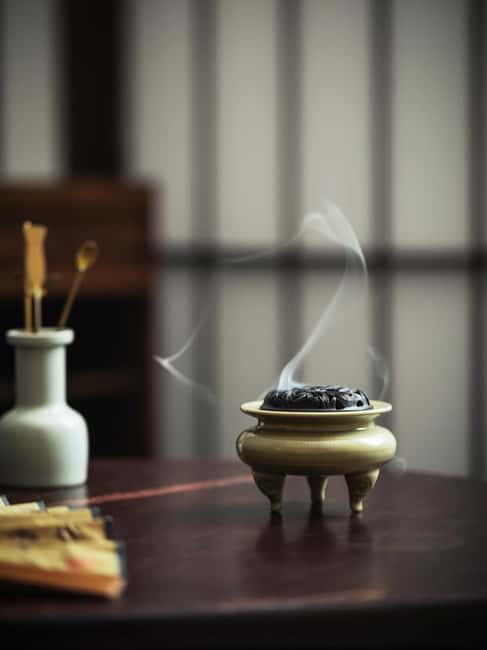
The setting has a traditional tea-room feel, with an atmosphere compared to a Chinese scholar’s study. That matters. Calligraphy is not just a worksheet at a desk. The ink, paper, tea, and slower rhythm help you understand how the activity fits into Chinese cultural life.
The address is in Beilin District, an area closely associated with Xi’an’s old city and cultural sights. The workshop itself does not replace a visit to a museum or monument, but it pairs well with a day focused on the city’s long past.
Beginning with tea, tools, and cultural context
The experience includes tea service and local snacks, and tea is woven into the session rather than treated as an afterthought. You can expect time to enjoy a traditional Chinese tea while learning about the setting and the relationship between tea culture and quiet study.
All writing materials are provided. That includes ink, paper, and an inkstone, along with the brushes and other supplies needed for the activity. You do not need to arrive with specialist equipment or prior practice.
The opening discussion covers the development of Chinese characters across about 3,000 years. This is one of the most useful parts for a first-time student because it gives meaning to the shapes you are about to copy. A character is not simply a picture to reproduce neatly. Its form, sound, history, and meaning all affect how you approach it.
Yunyun’s teaching style is a strong reason to choose this class. She explains clearly, works patiently with beginners, and creates an easy atmosphere for people who may feel nervous about making mistakes. That is important in calligraphy, where a shaky first stroke can make you feel as if you have failed before the lesson has begun.
You have the benefit of English instruction throughout. The language support is particularly useful when you are learning both a physical skill and cultural ideas at once.
Practicing the first brushstrokes
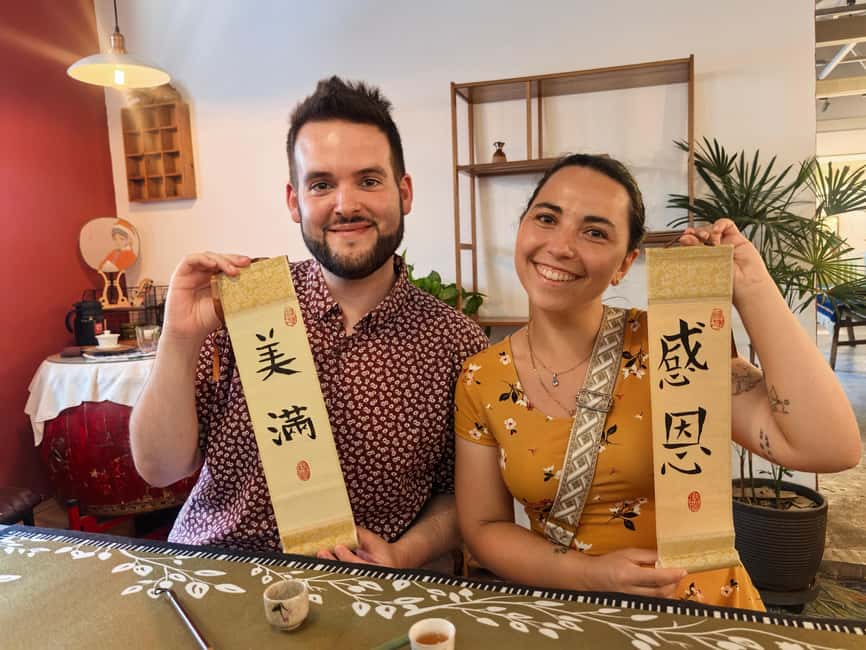
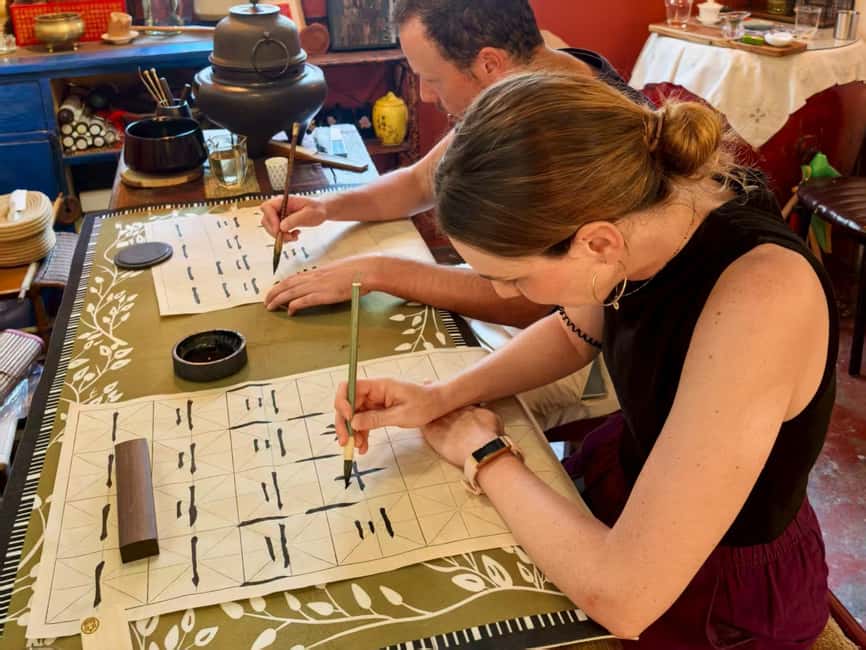
The practical work begins with basic strokes. You learn how to control the brush and put together simple lines before moving toward complete characters. This order makes sense: Chinese calligraphy depends on stroke direction, balance, spacing, and pressure, not just on tracing a finished shape.
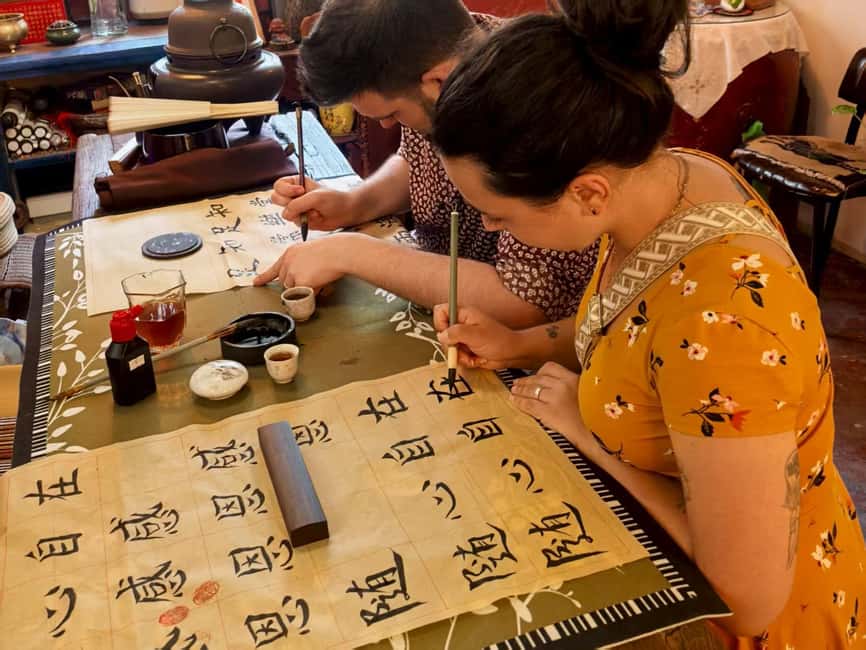
The first characters are deliberately approachable. You practice 一, meaning one, and 十, meaning ten, before moving to 大, meaning big, and 小, meaning small. These characters use relatively clear forms, so they help you see how small changes in line and proportion change the whole result.
米, meaning rice, adds another useful step. It gives you a more involved shape and shows how separate strokes need to work together. You may find that your hand tires or that the ink behaves differently from a familiar pen. That is normal, and the small group gives you a chance to ask for help instead of quietly falling behind.
The class also introduces characters with larger emotional or cultural associations. 永 means forever, 龙 means dragon, 武 relates to martial spirit, and 爱 means love. These are memorable choices because they connect the physical act of writing with ideas you may want to take home.
You also learn to write your name in Chinese characters. This is a highlight for many people because it turns the lesson into something personal. Keep in mind that writing a name in Chinese is not always a simple letter-for-letter conversion. The instructor’s guidance is valuable here, since the selected characters need to work in Chinese as well as represent your name.
Same place, a different pot:
- One-Day Hangzhou Dragon Well Tea Culture & West Lake Private Tour
★ 5.0 · 98 reviews - Traditional Chinese Tea Ceremony Experience
★ 4.7 · 74 reviews - Beijing Culture: Tea Ceremony, Heritage Instrument & Calligraphy
★ 5.0 · 57 reviews - Authentic Hangzhou Longjing Tea Culture Experience Tour
★ 5.0 · 32 reviews
Creating a fan or scroll to take home
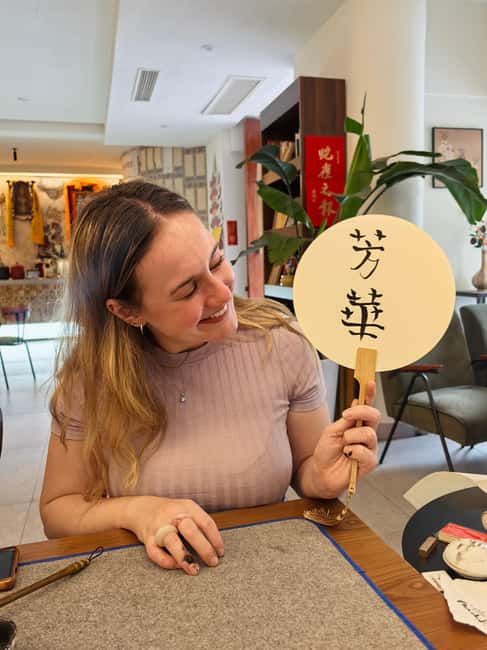
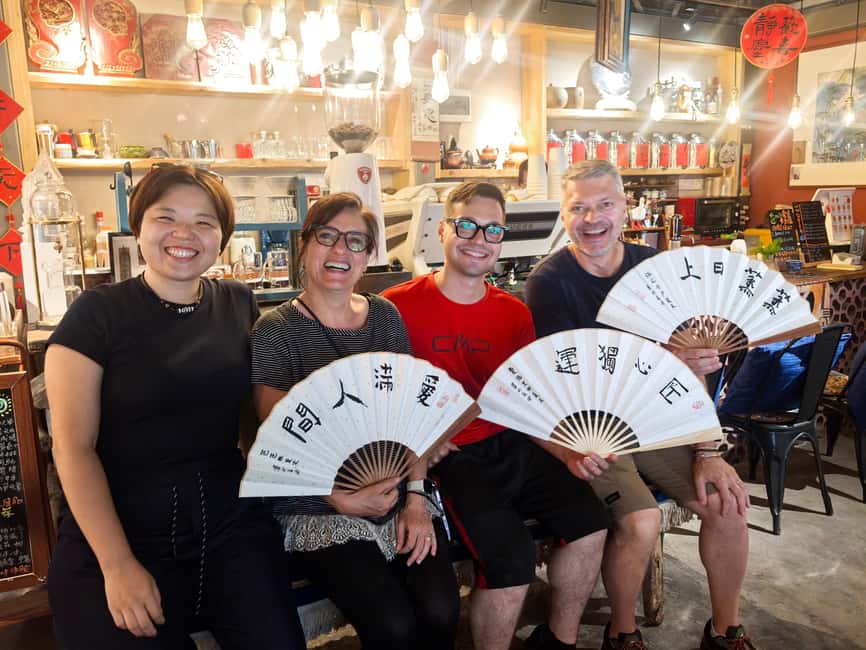
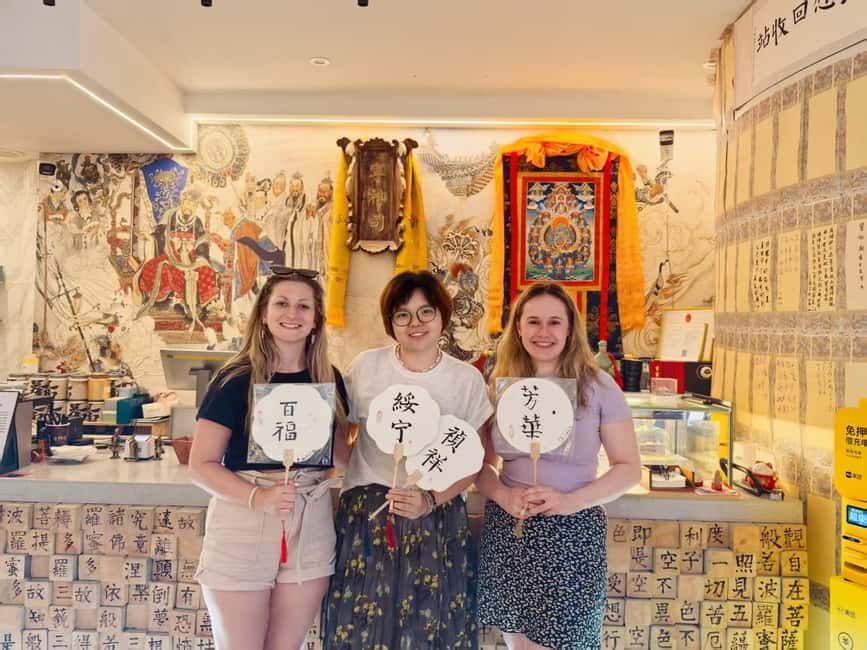
After practicing on paper, you choose between a painted folding fan and a traditional scroll painting. Your favorite words or a sentence can then be written on the piece, creating an artwork that is personal to you.
The fan is likely the practical choice if you want something light and easy to pack. It can also serve as a visible reminder of Xi’an without taking much room in your luggage. The scroll may appeal more if you want a formal piece for display at home.
You also create personalized bookmarks. These add a useful little extra to the main artwork. A fan or scroll can feel special but may spend much of its time stored away. A bookmark is easy to use and gives you another chance to see the characters you practiced.
The finished work will reflect your level of experience. Do not expect a professional artist’s result after one session. The value is in the personal connection: you selected the words, held the brush, and learned why the characters look the way they do.
I would ask the instructor early about the available choices for the fan or scroll if you have a particular idea in mind. The supplied information confirms that you choose one, but does not specify how many words or how much text can fit on the final piece. A simple phrase may work better than a long sentence.
What the three hours feel like
The three-hour duration gives the class enough room for explanation, practice, tea, and the final artwork without forcing every stage into a rushed demonstration. It is longer than a quick tourist craft stop, but short enough to fit into a busy Xi’an schedule.
A likely rhythm is:
- An introduction to the setting, tea, tools, and character history
- Demonstration and practice of basic brushstrokes
- Work with simple and meaningful characters
- Help writing your Chinese name
- Tea, local snacks, and discussion
- Selection and creation of a fan or scroll
- Completion of personalized bookmarks
The precise order may vary, but the important point is that the class combines learning with making. You are not sitting through a talk for three hours, and you are not rushed straight into painting without context.
A small group of up to eight is a real advantage. Calligraphy requires individual correction, especially when you are learning how to hold the brush and place each stroke. A large class could turn the lesson into a demonstration viewed from the back. Here, you have a better chance to receive direct guidance.
The class is wheelchair accessible, which makes the setting more workable for many visitors. Children under 12 are not suitable for this activity, so families should plan around the age limit.
What previous participants appreciated most
The strongest praise centers on Yunyun. Lorenzo described her explanations as clear and patient, and appreciated how she made a difficult subject feel relaxed and interesting. That combination is valuable because calligraphy can seem intimidating to people who cannot read Chinese.
Anze arrived as a complete beginner in both Chinese and calligraphy and found the instructions easy to follow. The tea room atmosphere also helped make the activity feel special. Anze had taken a separate walking tour with Yunyun earlier that day, which suggests that combining this workshop with another activity led by her may create a more connected introduction to Xi’an.
Daniel particularly enjoyed learning about both tea and calligraphy, while Barbara praised the friendly instruction, brush writing, fan decoration, and tea tasting. The repeated pattern is clear: the best parts are the personal teaching, the gentle pace, and the mix of cultural explanation with a physical keepsake.
The small number of published ratings is worth noting. The score is 5 out of 5 from four reviews, which is encouraging, but it is not a large sample. I would treat the feedback as strong evidence of a good personal experience, not as proof that every session will be identical.
Is $55 a fair price?
At $55 per person, this is not the cheapest way to spend three hours in Xi’an. You can drink tea for less, and you can buy a fan or bookmark without taking a class. The value comes from combining several elements in one guided session.
Your price includes English instruction, tea, local snacks, ink, paper, an inkstone, professional guidance, one painted fan or traditional scroll, and personalized bookmarks. The materials alone are only part of the equation. You are also paying for a small class where the instructor can help you directly.
I think the price is reasonable if you care about learning and want a meaningful object connected to your time in Xi’an. It is less convincing if you only want a quick souvenir or have little interest in Chinese writing.
The keepsake also has more meaning than a ready-made purchase. You choose the words, practice the characters, and take part in the making. That personal link is the main reason I would choose this over simply shopping for calligraphy in a market.
Who should book this class?
I would recommend it to first-time visitors who want a quieter cultural activity between major sights. It is also a good fit for culture enthusiasts, small groups of friends, and adults or older children who enjoy making something with their hands.
The class can work well for urban residents seeking a calm break from a busy routine. The slow brush movements and tea service create a mindful hour or two, even if you arrive with no interest in becoming a serious calligrapher.
Couples and families with children age 12 or older may like the shared project, especially because each person can choose different characters or a different personal message. Groups should remember that the maximum is eight, so larger parties may need separate arrangements.
I would not choose it if you need a fast, highly active attraction, or if your schedule cannot spare three hours. It is also not designed for young children under 12.
Booking is flexible, with free cancellation up to 24 hours before the activity and a reserve-now, pay-later option. Those terms are useful when your Xi’an plans are still shifting, but the main decision should be whether you want a patient, craft-based cultural lesson.
Should you book the Xi’an calligraphy workshop?
Book it if you want to slow down, learn a few meaningful Chinese characters, and take home something you made yourself. Yunyun’s clear English instruction and patient manner are the biggest reasons this class works for beginners.
Choose the fan if you want a light, decorative keepsake, or the scroll if you prefer something intended for display. Bring the Chinese meeting address, allow the full three hours, and arrive ready to practice rather than perform perfectly.
At $55, this is a good-value cultural experience for people who want more than a photo stop. It is a modest investment for a personal introduction to Chinese writing, tea, and the spirit of old Chang’an.
FAQ
How long does the Xi’an Chinese calligraphy workshop last?
The workshop lasts three hours. It includes calligraphy instruction, character practice, tea service with local snacks, and the creation of a fan or scroll plus personalized bookmarks.
How much does the workshop cost?
The price is $55 per person.
Is the class taught in English?
Yes. The instructor teaches in English.
What materials are included?
All writing materials are provided, including ink, paper, and an inkstone. Professional calligraphy instruction, tea, local snacks, personalized bookmarks, and your choice of a painted folding fan or traditional scroll painting are also included.
Can I choose between a fan and a scroll?
Yes. You can choose one of two final artwork options: a painted folding fan or a traditional scroll painting.
Is the workshop suitable for children?
The activity is not suitable for children under 12. It is intended for beginners, culture enthusiasts, families with older children, and small groups of friends.
More Food and Drink Tours in China
- Shanghai 3-Hour Afternoon Tea Tasting and Dessert Tour
★ 4.9 · 15 reviews - Unlock Chinese Tea: Culture, Science, Tasting & Hands-on Brewing
★ 5.0 · 12 reviews - Tea Tasting & Brewing Experience
★ 5.0 · 10 reviews - 3-hour Morning/Afternoon Tea Tasting on Maliandao Street & Dimsum
★ 5.0 · 7 reviews
More Tea and Calligraphy Workshops in China
- Beijing Culture Event: Tradition Music, Tea Ceremony, Calligraphy
★ 5.0 · 11 reviews - Beijing Hands-On Culture Tour: Tea, Instrument, Calligraphy
★ 5.0 · 6 reviews - Xi’an Calligraphy & Tea Ceremony – Dive into Ink & Brush Artistry
★ 5.0 · 4 reviews - Beijing:Learn Calligraphy & Enjoy Kung Fu Tea Ceremony
★ 5.0 · 2 reviews
Just added around China
- Full-day Tour: Spectacular Sunrise, Tea Plantation & Sunset★ 5.0 · 3 reviews
- Chinese Tea Ceremony Experience★ 5.0 · 3 reviews
- Unlock Chinese Tea: Culture, Science, Tasting & Hands-on Brewing★ 5.0 · 12 reviews
- Shanghai Mahjong Experience in Local Tea Bar★ 5.0 · 4 reviews
- Private Tour Hangzhou West Lake and Tea Fields Discovery★ 5.0 · 3 reviews
- Half-Day Hangzhou Jiuxi Stream and Tea Plantation Experience★ 5.0 · 2 reviews
- Hangzhou West Lake and Tea Plantation Half Day Tour★ 5.0 · 4 reviews
- Private Hangzhou Day Tour to West Lake, Lingyin Temple, Tea Village, Old Pagoda★ 5.0 · 17 reviews
Tea Tastings in China, compared.
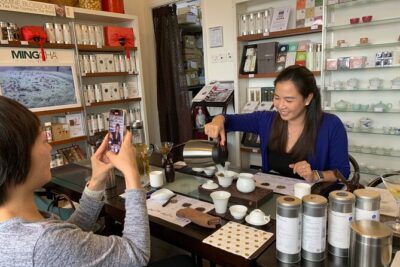

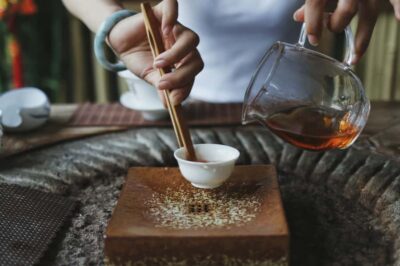
Shanghai 3-Hour Afternoon Tea Tasting and Dessert Tour
Read our review →Private Shanghai City and Zhujiajiao Combo Tour with Boating, Tea Tasting, Lunch
Read our review →

3-hour Morning/Afternoon Tea Tasting on Maliandao Street & Dimsum
Read our review →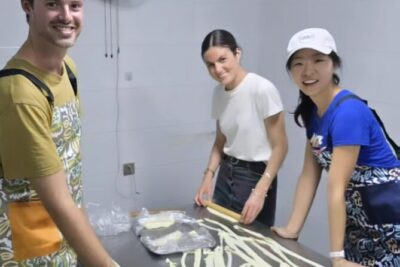

Guilin: City Tour with Elephant Hill & Ming Tea Tasting
Read our review →Browse the lists this tour appears in