
Review · MARRAKESH
Marrakech: Pottery Workshop with Moroccan Tea
Clay makes Marrakech feel personal. At Atelier Lamsaty, you get hands-on time with Moroccan pottery, from simple modeling to a short turn at the wheel. I like the patient guidance from Asma and her team, and I like that you take your wrapped creations home. The main drawback is location: the workshop sits outside the central sightseeing area, so a taxi adds time and cost.
This is a calm change from Marrakech’s busy streets. You can make a cup, box, tagine, or free-form piece, then pause for Moroccan tea while the clay dries on your hands. I also like the family-run atmosphere and multilingual help in English, French, and Arabic, though two hours is not long enough for a full pottery course or kiln-fired finished piece.
Key points at a glance
- Try two pottery methods: Shape clay by hand, then have a guided turn on the pottery wheel.
- Meet the Lamsaty team: Asma and the other women offer clear, patient help, including explanations in English and French.
- Take home your work: Pieces are wrapped at the end, ready for transport after the session.
- Plan for the drying time: Clay must dry for six days before firing, and you must remain in Marrakech for at least a week if you want biscuit firing arranged.
- Enjoy a mint tea break: Moroccan atay gives the class a pleasant pause between demonstrations and making.
- Allow extra travel time: The studio is about 10 minutes from the city center by taxi and 15 minutes from the Medina.
What makes this Marrakech pottery class worth your time

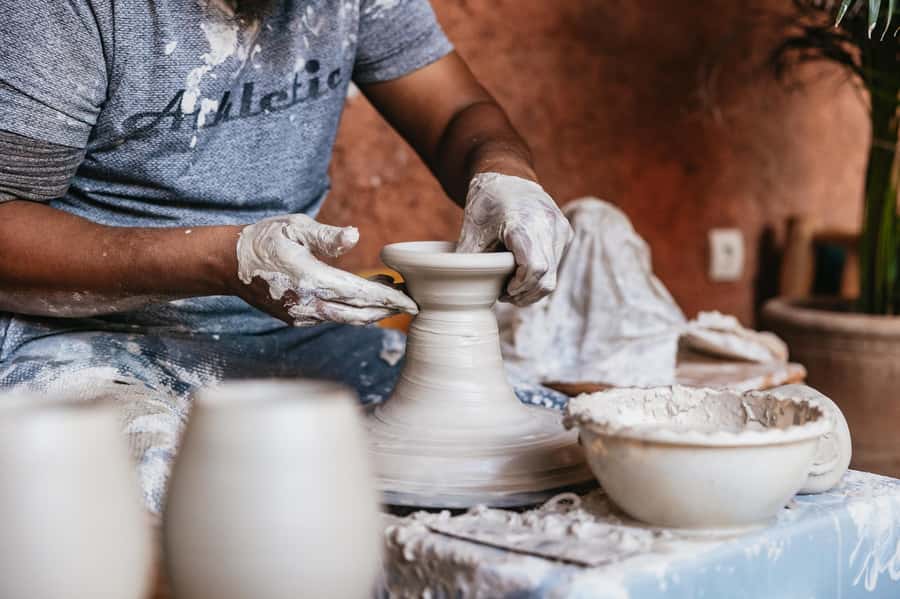
Marrakech offers plenty of sightseeing, but much of it asks you to look, photograph, and move on. This workshop gives you something to do with your hands. You sit with clay, learn how it responds to pressure, and make an object that carries a little of your time in Morocco.
Atelier Lamsaty is a pottery and embroidery workshop in the Al Massar district. It is in front of the AHMA Construction building, about 10 minutes from the city center by taxi. From the Medina, allow about 15 minutes according to the activity information, though the exact journey depends on traffic and your starting point.
I see the class as a good fit for first-timers. You do not need to arrive with pottery skills or a plan for a perfect vase. The instructors explain the tools, show the basic movements, and step in when your clay begins to lean, crack, or lose its shape. That hands-on help matters, especially on the wheel, where even a simple cylinder can become a lopsided bowl in seconds.
The class also suits couples, friends, and families. Several children have enjoyed working with the clay, although the official guidance excludes children under 90 centimeters tall. If you bring a young child, expect the adults and instructors to provide close help rather than treating this as an independent children’s activity.
More Mint Tea Experiences in Morocco:
- Marrakech: Medina by Night Walking Tour with Moroccan Tea
★ 4.6 · 586 reviews - Marrakech: Agafay Desert Quad Bike Tour with Moroccan Tea
★ 4.6 · 216 reviews - Lamsaty Pottery Workshop with Moroccan Tea
★ 5.0 · 75 reviews
Your first 15 minutes: watch before you shape
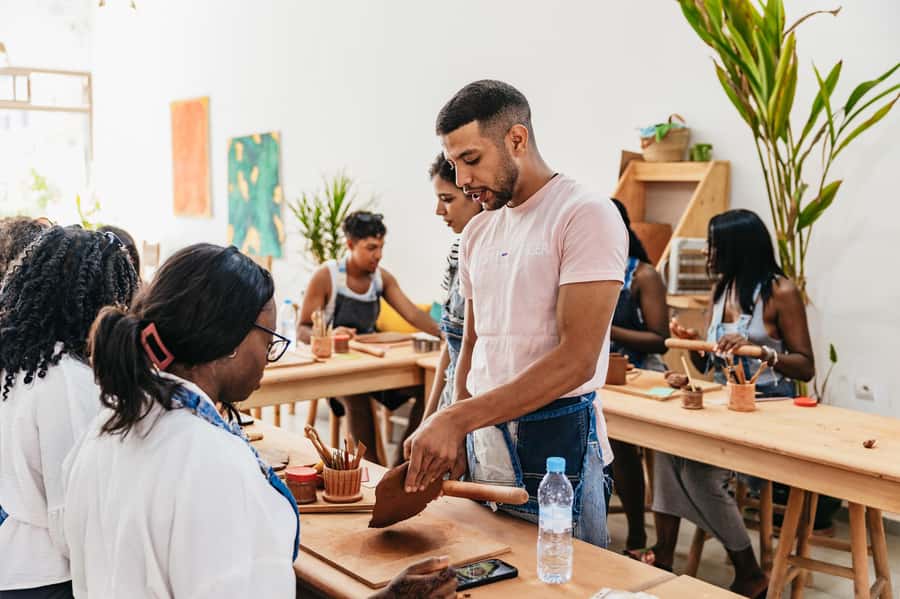
The class begins with a demonstration lasting about 15 minutes. This introduction covers the basic pottery methods and gives you a useful look at how the instructors handle clay before you try it yourself.
You will learn about modeling, sculpture, and turning. Modeling means shaping the clay by hand, which gives you more freedom and less pressure. You can make a cup, a small box, a tagine, or another simple form using tools and decorative cutouts supplied at the studio.
Turning refers to work on the pottery wheel. The wheel is the more technical part of the experience. Your hands need to work together while the clay spins, and small changes in pressure can alter the entire shape. The staff guide your hand position and help you begin forming the clay, but the point is to let you try it rather than watch an expert do everything.
That distinction is important. This is not a demonstration with a quick photo opportunity at the end. You get to handle the materials and attempt the techniques yourself. At the same time, the short session means you should not expect to master wheel throwing. You will get an introduction, not a full professional lesson.
Hand-building clay into a cup, box, or tagine
After the demonstration, you move into the practical part of the class. You can shape a small object by hand, using the tools and materials provided. The studio offers different pattern choices and cutouts, so you can add texture or decoration instead of leaving the surface plain.
Hand-building is likely to be the less intimidating choice for beginners. You can take your time, adjust the form, and focus on the feel of the clay. A cup or box gives you a clear target, while a tagine shape connects the activity to Moroccan cooking and household design.
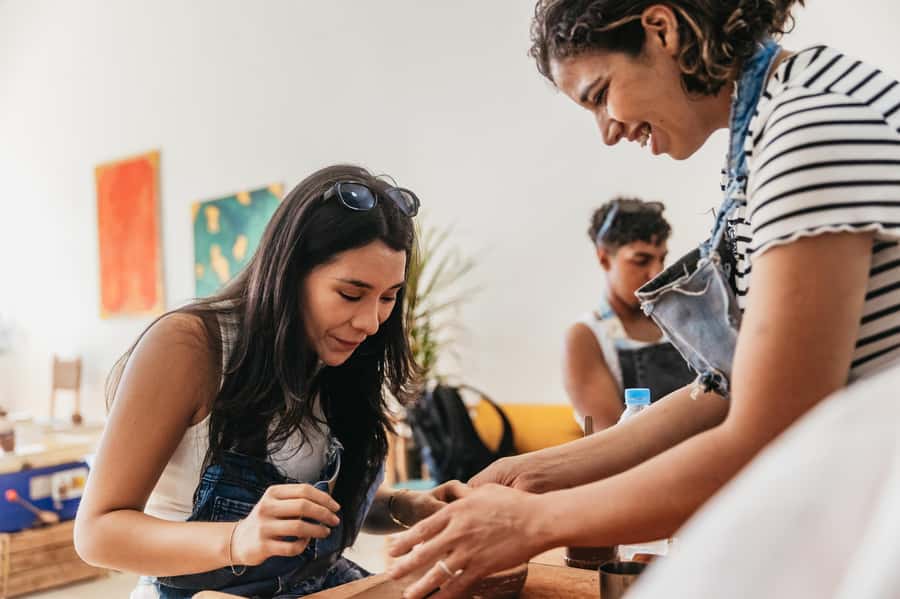
The staff do not simply leave you at a table with clay. Asma and the other instructors are praised for being patient, kind, and willing to repeat instructions when needed. English, French, and Arabic are spoken, which helps if your group includes people using different languages.
You should still expect uneven results. Clay is forgiving, but it is not magic. A handmade cup may have a slightly irregular rim, and a small sculpture may look different from your first idea. That is part of the appeal. You are making a personal souvenir, not buying a factory-perfect object.
The pottery wheel: fun, tricky, and shorter than you may hope
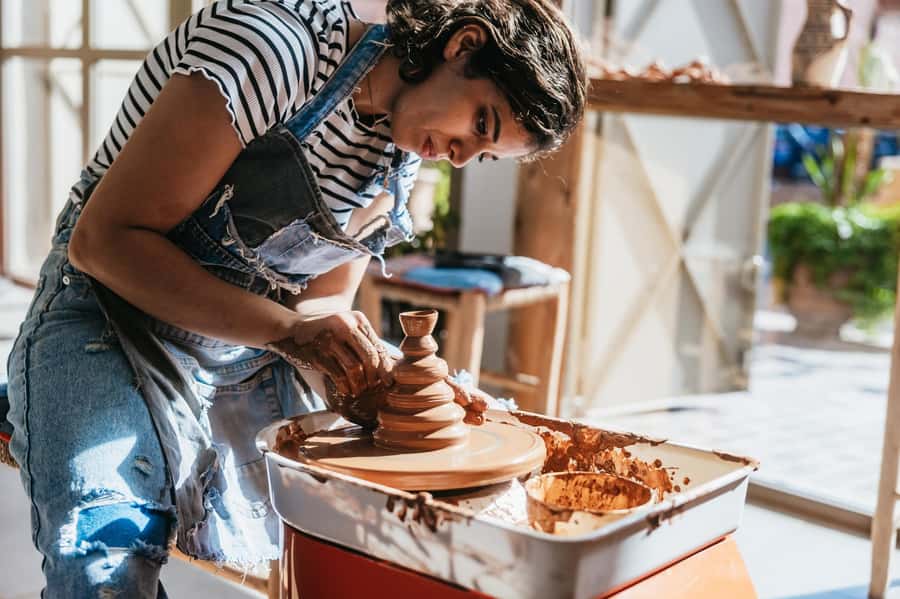
The wheel is often the moment people remember most. You sit at the machine, place your hands on the clay, and try to keep the spinning form centered. The instructors help with positioning and show you how to begin pulling the clay upward and outward.
I would approach this part with modest expectations. Two hours must be shared among the demonstration, hand-building, wheel practice, tea, and cleanup. Depending on the group, your time on the spinning machine may be brief. The class gives you a taste of wheel throwing, but it does not provide the long practice needed to produce a refined vessel.
That limitation is not necessarily a flaw. A first attempt can be surprisingly difficult, and a short session keeps the activity light rather than turning it into a demanding technical course. You get the fun of trying the wheel without committing several days to learning it.
If the wheel is your main reason for booking, arrive ready to listen closely and make the most of your turn. If you want more time, ask the provider before booking whether longer practice is available. The advertised experience promises an opportunity to try the wheel, not an extended private lesson.
A few more tea experiences around Morocco worth a look
- Around Marrakech: Camel Ride in Palm Groves including Tea
★ 4.4 · 1,245 reviews - Tangier: Sunset, Tea, Sweets, Camel Ride, and Hercules Caves
★ 4.9 · 575 reviews - Sunset camel ride in Agadir with transport, tea and cakes.
★ 4.5 · 116 reviews - Marrakech: Moroccan Pastries and Tea Class with a Local
★ 4.7 · 84 reviews
A Moroccan tea break in the middle
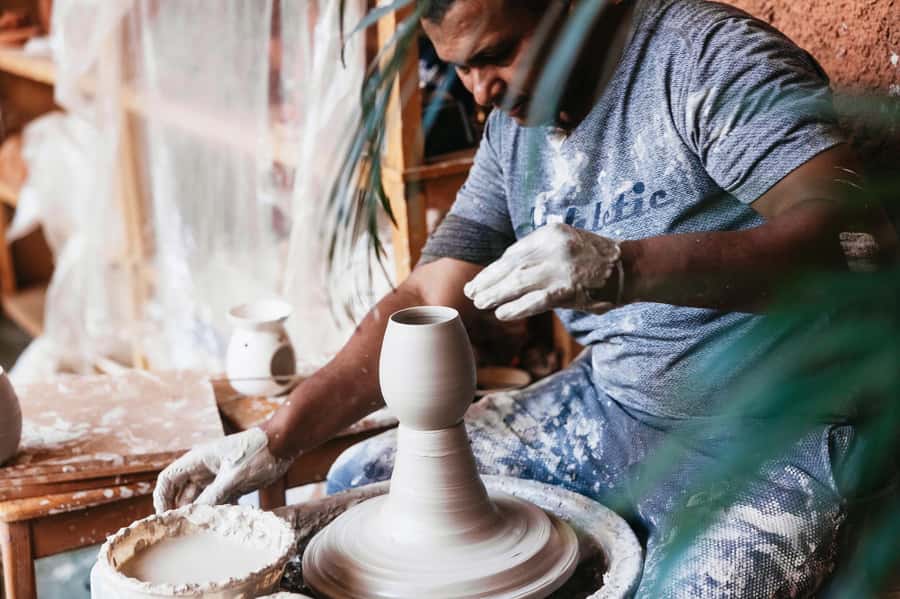
Halfway through the class, you pause for Moroccan tea. The tea is included in the $45 price, and it gives you a chance to sit back before returning to the clay.
This is a small part of the schedule, but it helps the class feel connected to local hospitality rather than like a generic craft lesson. The warm atay also breaks up the concentration required for shaping and turning. Pottery can be quiet work, and the pause gives the group time to chat and compare what they are making.
The included drink is Moroccan tea. Other refrigerated drinks may be available for purchase, but they are not part of the package. If you want food, plan separately, since meals and snacks are not included.
Taking your pottery home
At the end of the session, the staff carefully wrap your creations. That is useful if you are traveling around Morocco or flying home soon. Bring enough room in your luggage for an object that may be awkwardly shaped, even when packed well.
Your piece will not be a finished, glazed ceramic object when you leave. It needs to dry first. The activity information warns that any piece containing water can explode in the kiln, so a drying period of six days is required before firing.
You can let the pieces dry for a day and then decorate them with the paint of your choice. If you will stay in Marrakech for at least one week after the class, the workshop can also fire your work with a biscuit firing before you paint it. The timing matters, so do not assume firing is possible if you are leaving the city the next morning.
This is one of the most important practical details. The advertised two hours covers the class, not the entire ceramic process. Your immediate souvenir is the wrapped, unfired piece. A later firing depends on enough drying time and your remaining in Marrakech for the required period.
The family-run atmosphere and studio setting
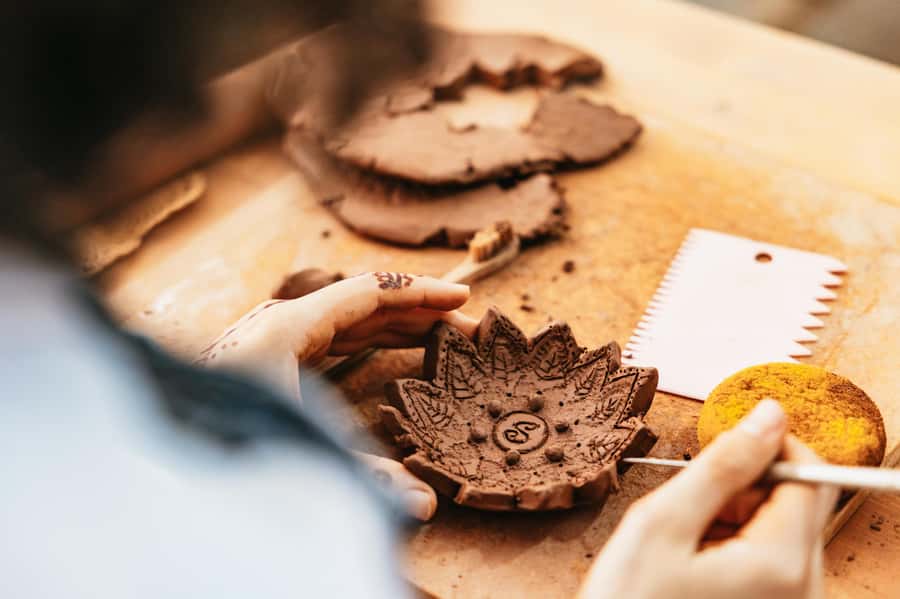
The workshop has a relaxed, welcoming feel. The family-run team includes several women who help with the class, answer questions, and offer personal guidance. Asma is specifically noted for explaining the process carefully and accommodating people working in different languages.
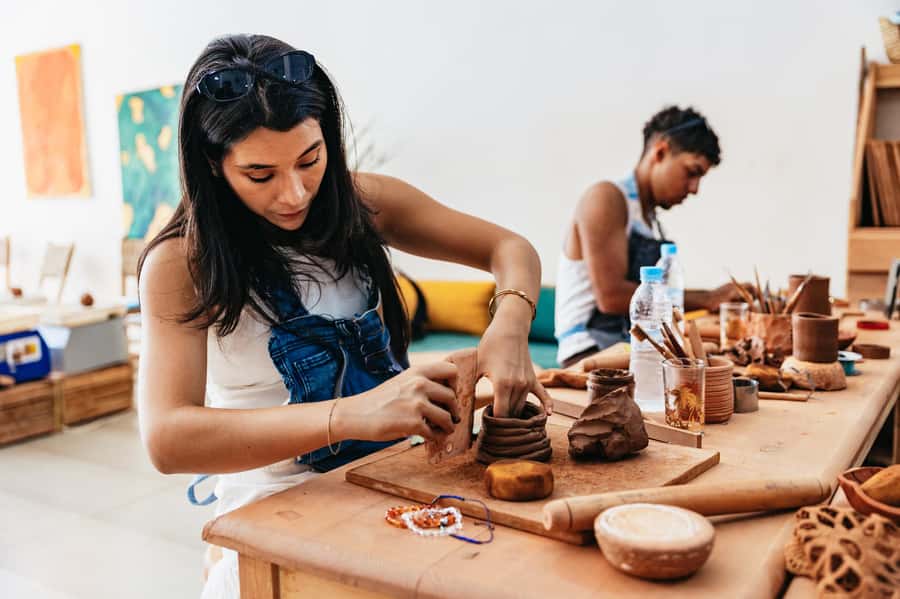
The studio is described as clean, organized, spacious, and artistic. An apron is provided, which is helpful because clay can be messy. You may hear music during the session, and the combination of music, tea, and practical work gives the class a gentle pace.
The setting also includes a shop with handmade items for sale. Bring cash or a card if you want to browse and buy something beyond your own creation. Purchases from the shop are not included in the workshop price.
The warm atmosphere is one of the strongest reasons to choose this class. You are not only learning a craft technique. You are spending time with local makers and seeing how a working creative space operates. The experience remains accessible, though it does not pretend to be a formal art-school course.
Getting to Atelier Lamsaty without wasting your afternoon
The workshop is not in the center of the Medina. You meet at Atelier Lamsaty Pottery and Embroidery Activity, in front of the AHMA Construction building.
A taxi from the city center takes about 10 minutes, while the stated journey from the Medina is about 15 minutes. Traffic, pickup points, and the exact location of your accommodation can change that estimate. One practical warning: the studio can be hard to find, so save the address and meeting details before leaving.
A past participant paid 500 MAD for a long taxi journey from a resort, which shows how quickly transport can affect the total cost. That was a particularly expensive ride, not a fixed workshop transfer price, but you should still budget for transportation because it is not included.
Public transport may be possible for people familiar with Marrakech. One visitor specifically noted the L15 bus as an option, while another mentioned using the InDrive app for a cheaper ride. I would allow extra time for either choice, especially if you have never used the route before.
The location is the clearest trade-off. You lose some convenience compared with a class in the Medina, but you gain a purpose-built studio and a quieter break from the center.
Is $45 a fair price?
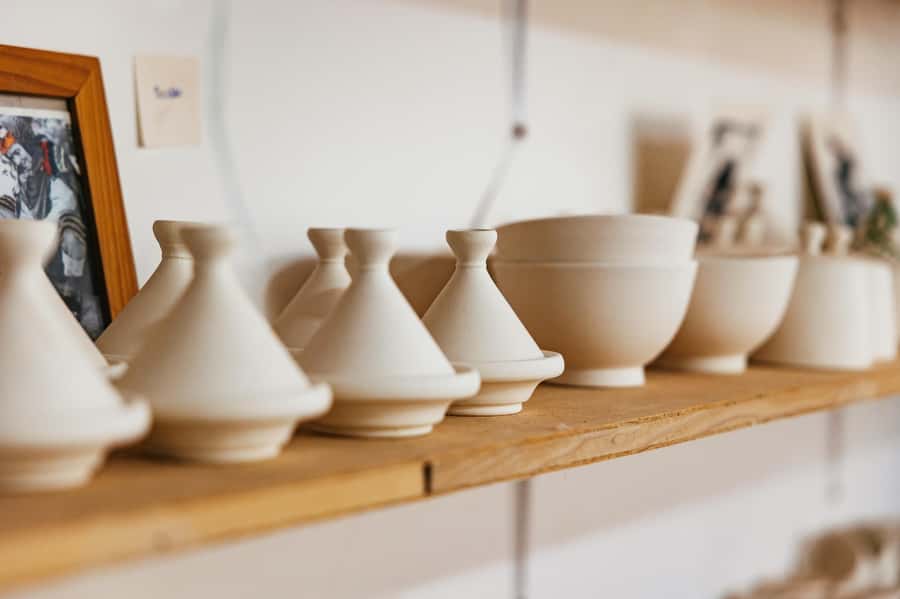
At $45 per person, the value depends on what you want from pottery. The price includes the instructor, tools, materials, Wi-Fi, Moroccan tea, and the pieces you make during the session. For a first-time creative activity with personal guidance, that is a reasonable package.
The cost feels stronger if you value the cultural setting and the finished souvenir. You are not paying only for clay. You are paying for instruction, access to equipment, help at the wheel, a hosted tea break, and the chance to make something yourself.
The value is weaker if you mainly want a long wheel-throwing lesson or several kiln-fired pieces. Wheel time can be limited when a group shares the equipment, and the standard class does not immediately produce fired pottery. Add taxi costs, and the final bill may feel less modest.
I would compare it with the price of another organized Marrakech activity, not with the cost of buying a small ceramic item in a souk. The class gives you an experience and a keepsake. If you only want a finished bowl, shopping may be cheaper and easier.
Who should book this class?
I would recommend it to first-time potters, couples, friends, and families with children above the stated height limit. It works especially well when you want two relaxed hours away from sightseeing and are happy to make something imperfect but personal.
It is also a good choice for creative people who enjoy learning by doing. The staff are patient, and the class welcomes beginners rather than assuming you understand pottery terms or tools.
I would hesitate if your schedule is tight, your hotel is far from Al Massar, or you need finished fired pottery before leaving Marrakech. I would also avoid booking it for children under 90 centimeters, since the activity is not suited to them.
Free cancellation is available up to 24 hours before the start time, and you can reserve now and pay later. Bring a card and cash, wear practical clothing, and remember that pets are not allowed.
Should you book Atelier Lamsaty?
Yes, if you want a friendly, hands-on cultural activity and understand what two hours can deliver. The strongest parts are the patient instruction, the chance to try both hand-building and the wheel, the Moroccan tea, and the wrapped creations you take home.
Book with realistic expectations. You will not become a trained potter in one session, and wheel time may be short. But for $45, Atelier Lamsaty gives you a personal souvenir, contact with a family-run craft studio, and a peaceful pause from Marrakech’s crowded center.
FAQ
How long does the pottery workshop last?
The workshop lasts two hours.
How much does the experience cost?
The price is $45 per person.
Where is Atelier Lamsaty located?
The workshop is in front of the AHMA Construction building, about 10 minutes from Marrakech city center by taxi and 15 minutes from the Medina.
What pottery techniques will I learn?
You can learn hand modeling, sculpture, and turning, with an opportunity to try the pottery wheel.
Can I choose what to make?
Yes. The practical session allows you to make a cup, box, tagine, or another modeled piece, and you can also try wheel throwing.
Is Moroccan tea included?
Yes. Moroccan tea is included, and it is served during a break halfway through the class.
Are tools and clay provided?
Yes. The workshop includes the instructor, tools, and materials.
Can I take my pottery home?
Yes. Your creations are carefully wrapped at the end of the session so you can take them with you.
Can the workshop fire my pottery?
If you stay in Marrakech for at least one week after the workshop, the pieces may receive a biscuit firing before you decorate them. The clay must dry for six days before firing.
What languages do the instructors speak?
The instructors speak English, French, and Arabic.
Just added around Morocco
- Desert Sunset Camel Ride With Free Tea in The Desert Camp★ 5.0 · 3 reviews
- Private Quad Biking Safari In The Palm Grove Of Marrakech And Berber Home Tea★ 5.0 · 3 reviews
- Sunset Sandboarding & Mint Tea in Timlaline Dunes★ 5.0 · 5 reviews
- Agadir Quad ATV Adventure Tour with Berber Tea Experience★ 5.0 · 18 reviews
- Marrakech: Agafay Desert Quad Bike, with Pool swim Lunch Tea★ 5.0 · 5 reviews
- Fez Outdoor Adventure: Quad Ride, Camel Photo & Mint Tea★ 5.0 · 2 reviews
- Agadir/Taghazout: Sandboarding & Sunset Tea with Fire Show★ 5.0 · 6 reviews
- Argan Forest, tea time at a Berbers family & Visit of an Argan cooperative.★ 5.0 · 21 reviews
Moroccan Mint Tea Experiences, compared.



Cairo Food Tour in local places & Egyptian Mint Tea
Read our review →

quad excursion at Jbilet desert with Moroccan tea
Read our review →
From Agadir/Taghazout: Buggy Safari Adventure & Moroccan Tea
Read our review →

Browse the lists this tour appears in